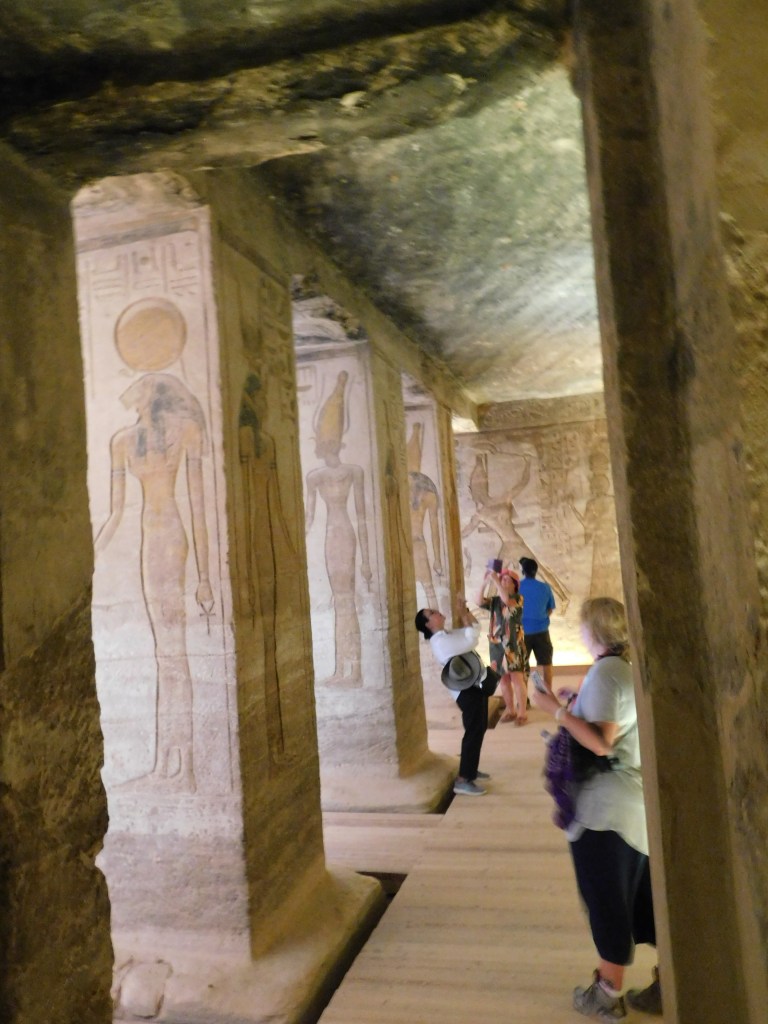
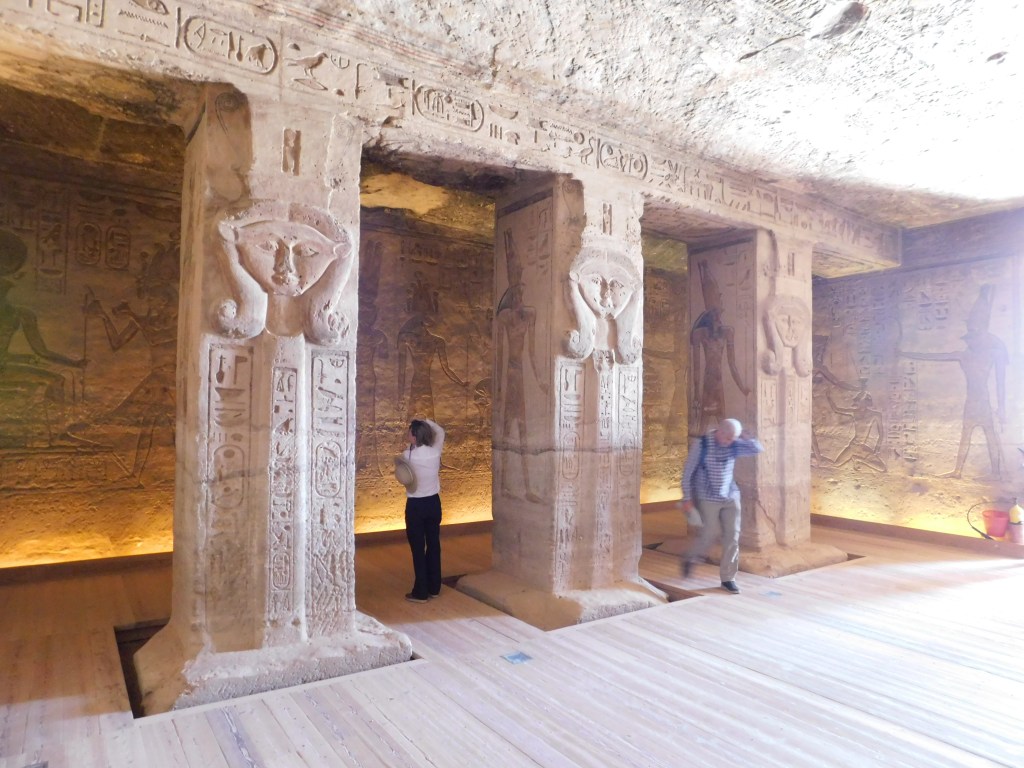
Aswan, Egypt – the Aswan Dam and the Temples at Abu Simbel.

August 25 – September 5, 2019

After Esna, we headed as far south as we could go on the Nile to the Aswan Dam. The dam was built during the 1960’s by Gamel Nassar, then Egypt’s president. The dam, known as the High Dam, replaced a smaller version up the river that had been built in the early 1900’s by the English, when they controlled Egypt. Annual and constant flooding by the Nile in the spring time was hurting the farming activities and villages that lived on or near the banks of the Nile. The new dam was seen as a way to control the flooding, produce electricity, and prevent the annual damage done by the river. While this plan succeeded, it also introduced major sediment deposits into the section before the dam that now needto be dealt with, as these sediments used to go downstream and actually provided the rich fertile soil of the Nile river banks.
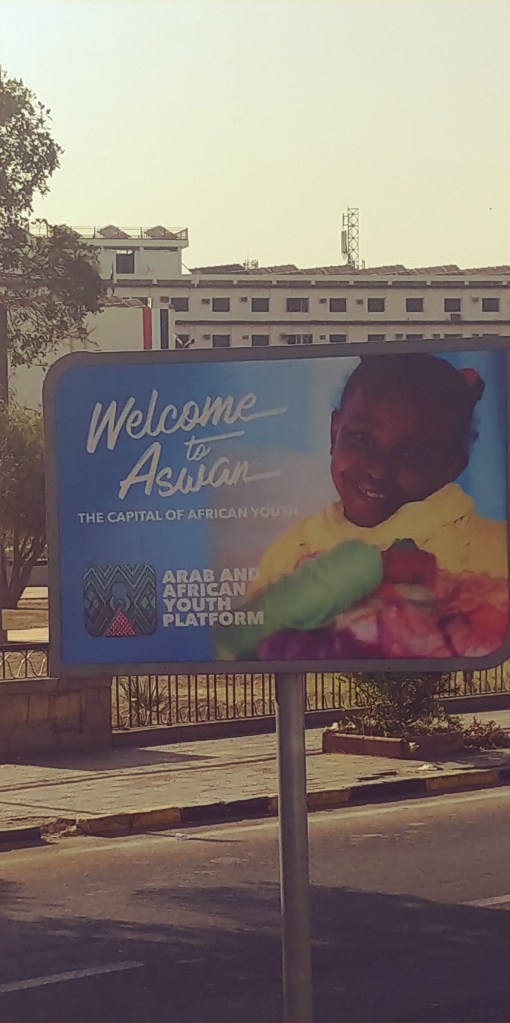
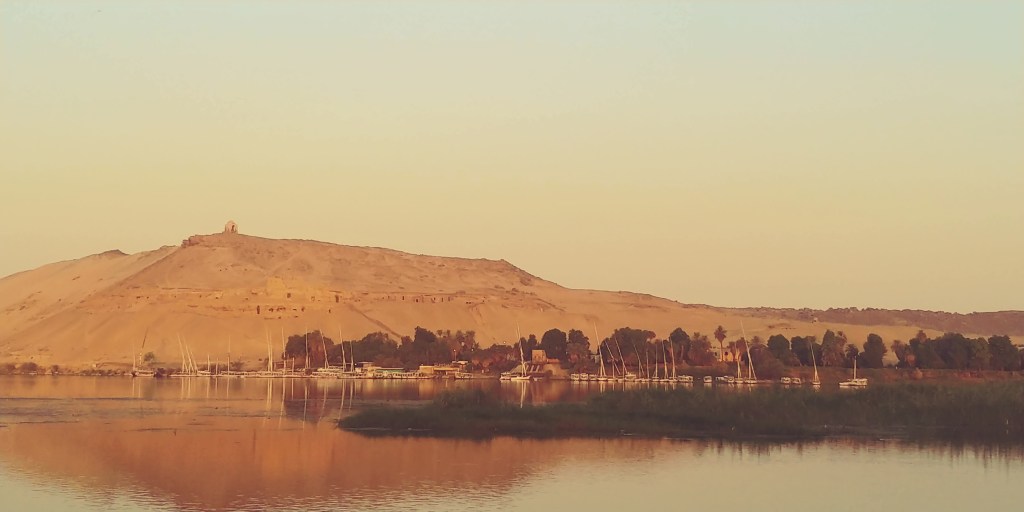
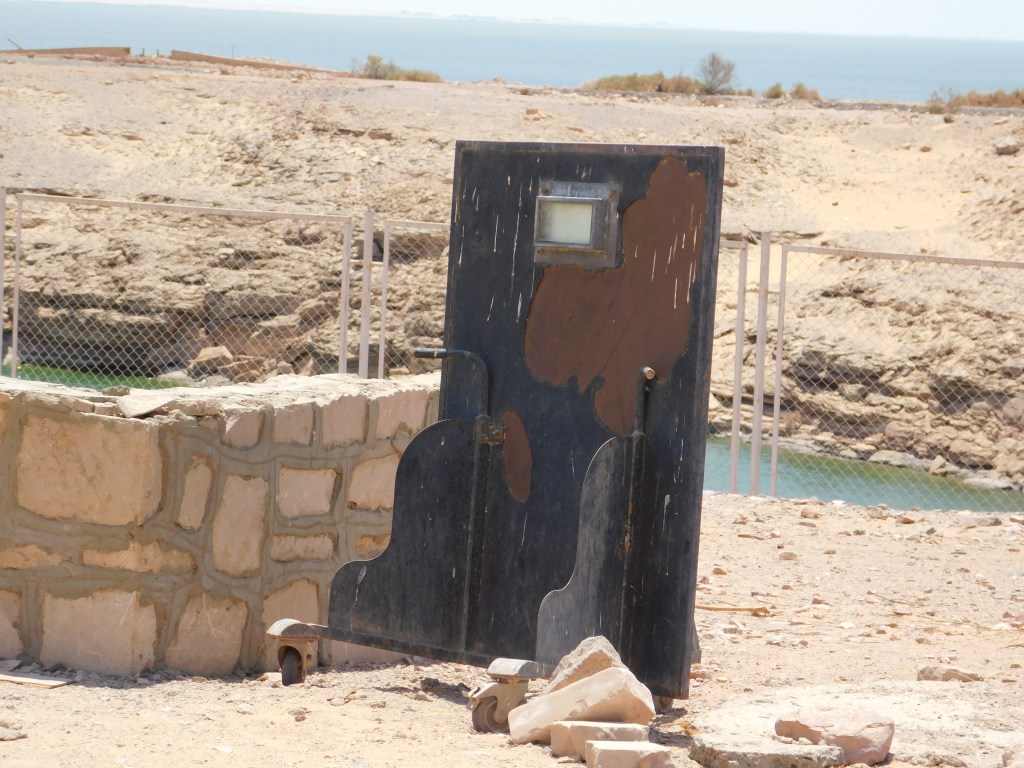
View of the tombs across Lake Nassar in Aswan.

The dam was financed by the then Soviet Union and designed and built by a Russian company based in Moscow. The completion of the dam also saw the construction of the Lotus Flower Monument which signified Egyptian and Soviet cooperation during the project.

We drove across the dam to the Aswan airport to board a plane to get to Abu Simbel. The Aswan airport is very small, very nice, and pretty much the only reason it exists is to shuttle people back and forth from Aswan to Abu Simbel. It is about an hour flight. We will fly back and forth the same day. So, that means we have preset departure and arrival times. What does that tell you, avid reader? Yep, the darn plane is an hour late arriving. We lost an hour’s time wandering around Abu Simbel. It still worked out OK as we were able to see this amazing site in it’s entirety.

While sitting around the airport we did see a pretty cool plane, a World War II American P38 taking off.
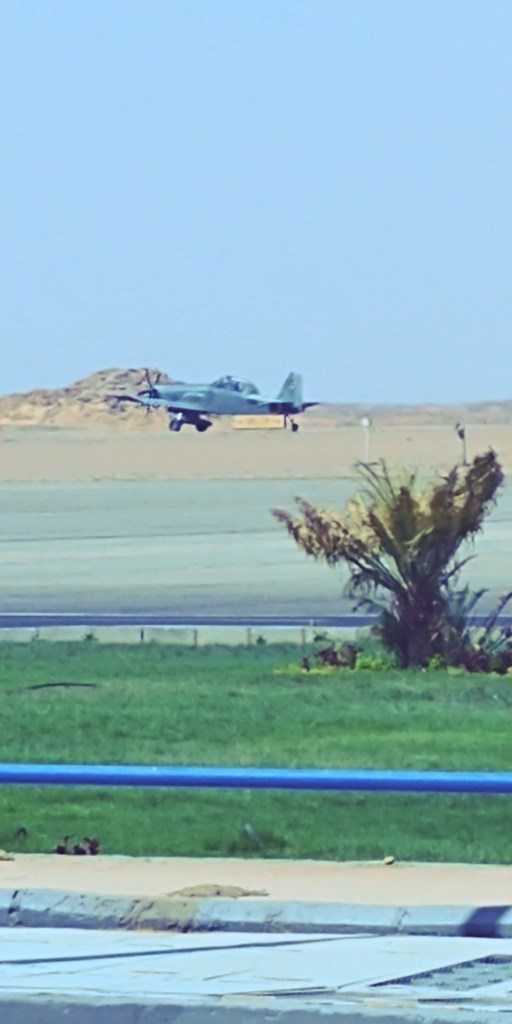
P38 taking off from Aswan Airport.

Remember how the dam was built in the 1960’s and created one of the world’s largest artificial bodies of water? Well, think about that. Before the lake was created, there were towns, farms, and yep, temples and tombs in the valley and hills of the now Lake Nassar. They had to move tens of thousands of people out of the valley. They also moved 22 precious archaeological sites. A lot of them went to museums and such, but these temples of Abu Simbel were moved in their entirety from their original location on the bank of the Nile River, to the top of the mountain that towered over them, about 250 feet up.
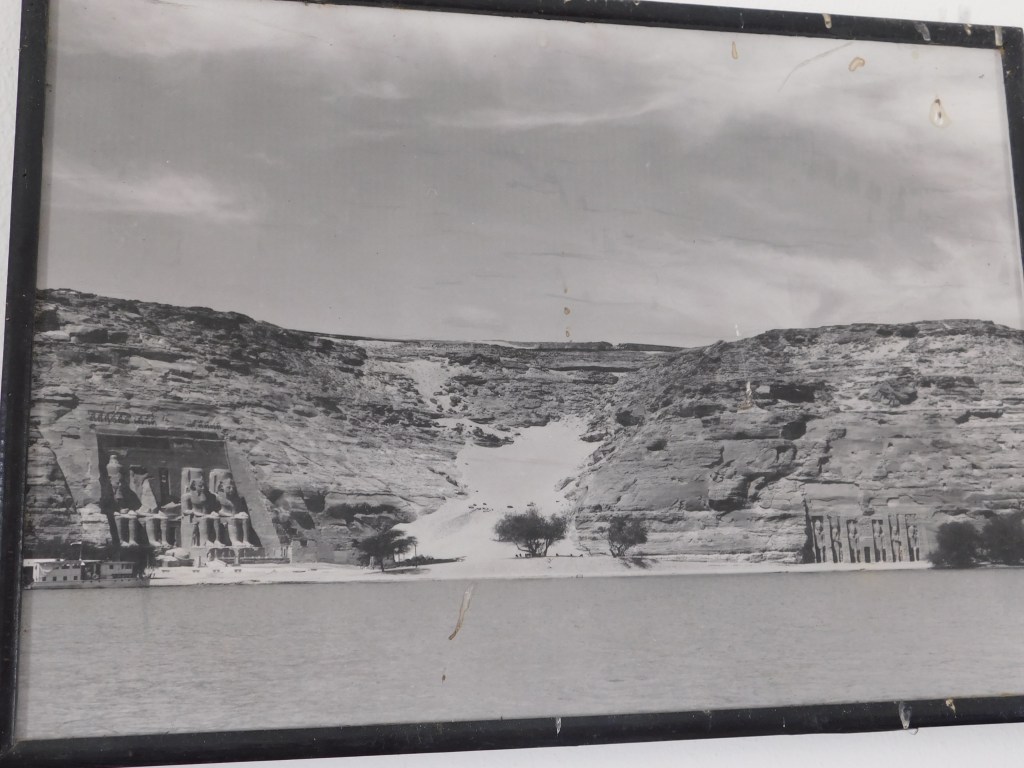
Picture from the 1960’s showing the original location of the Temples.

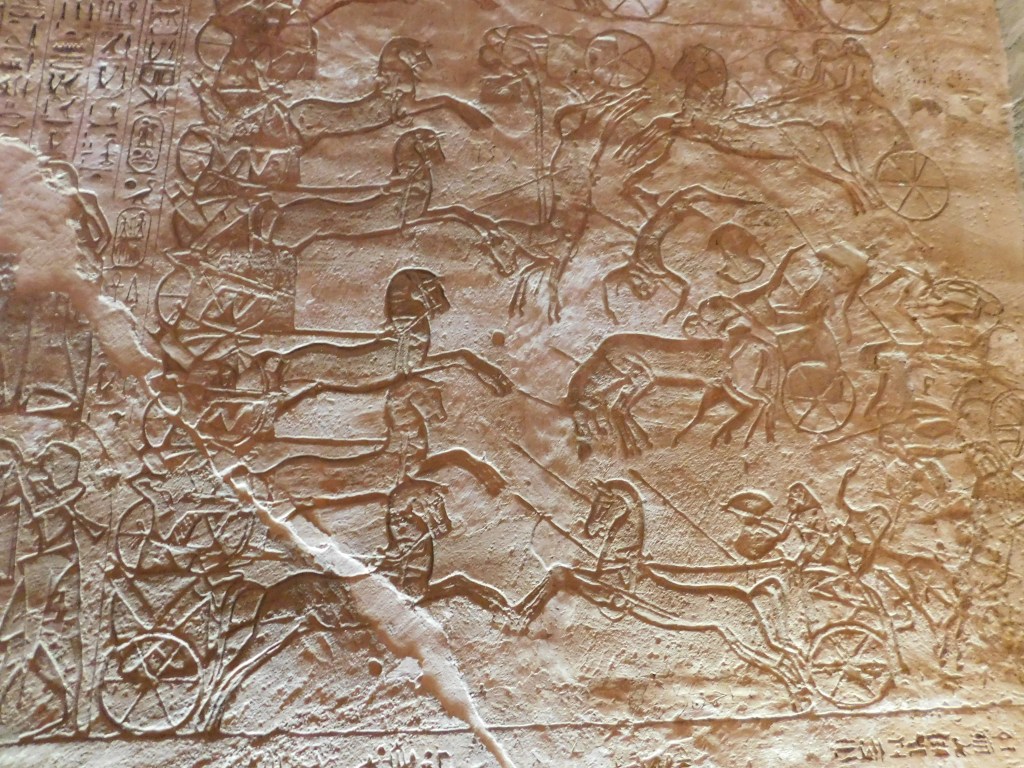
Ramses II built these temples 3,500 years ago to celebrate his great victory at the Battle of Kadesh. This battle featured the largest even recorded chariot battle in history. The chariots were estimated at between 5,000 – 6,000 in number. Ramses II defeated the Hitites in this battle, located near the current Lebanon-Syrian border.
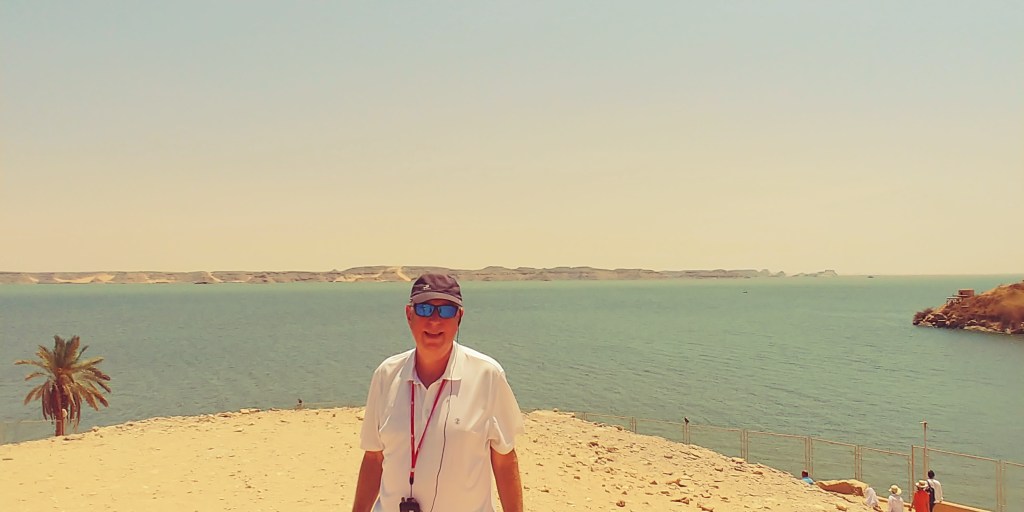
Randy on top of the artificial mountain housing the temples, overlooking Lake Nassar in Abu Simbel.
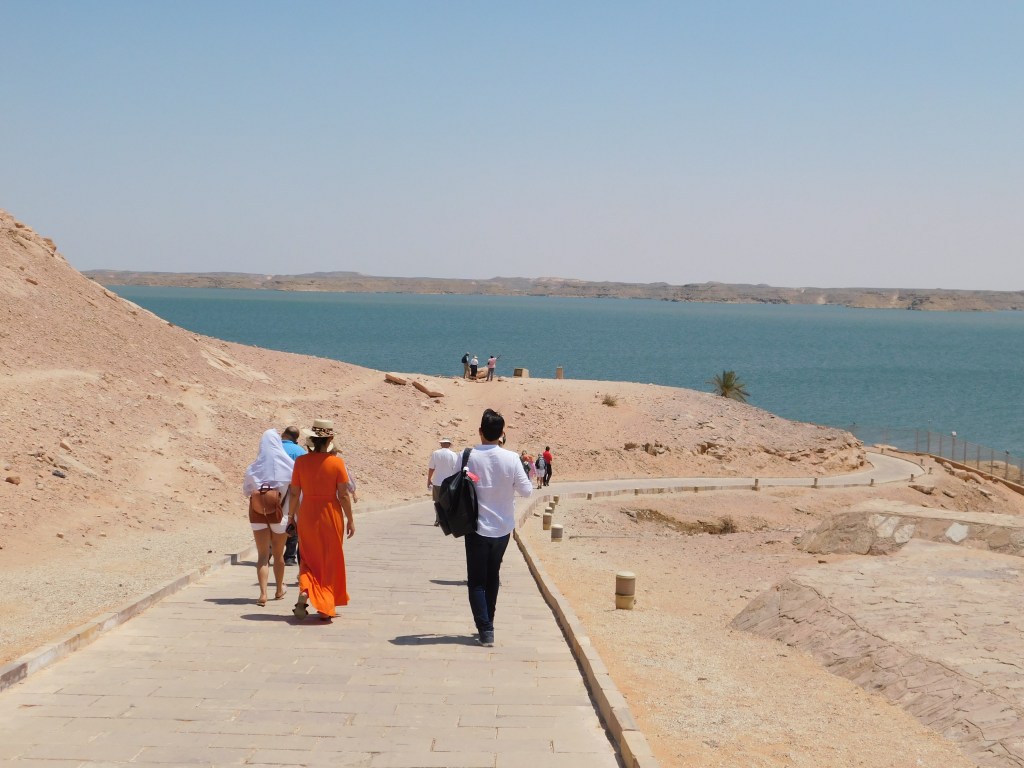
Pathway from the entrance around the mountain to the temple site.
And of course, the ever present military aspects.

We walk around the mountain path and are greeted by this fantastic image.
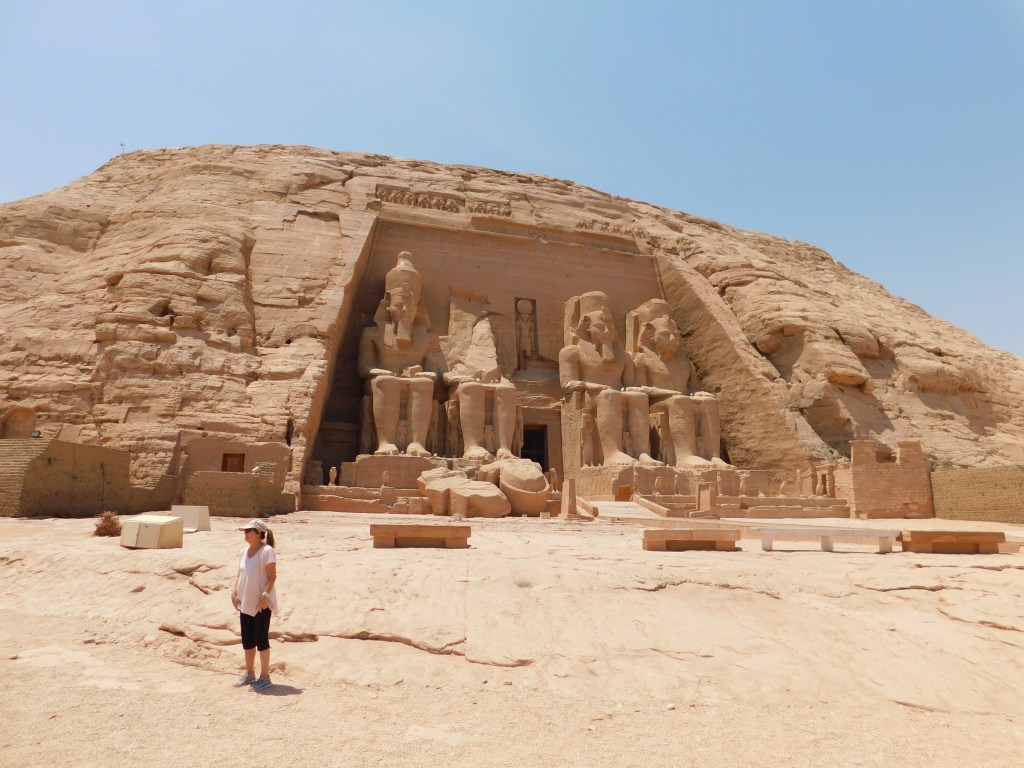
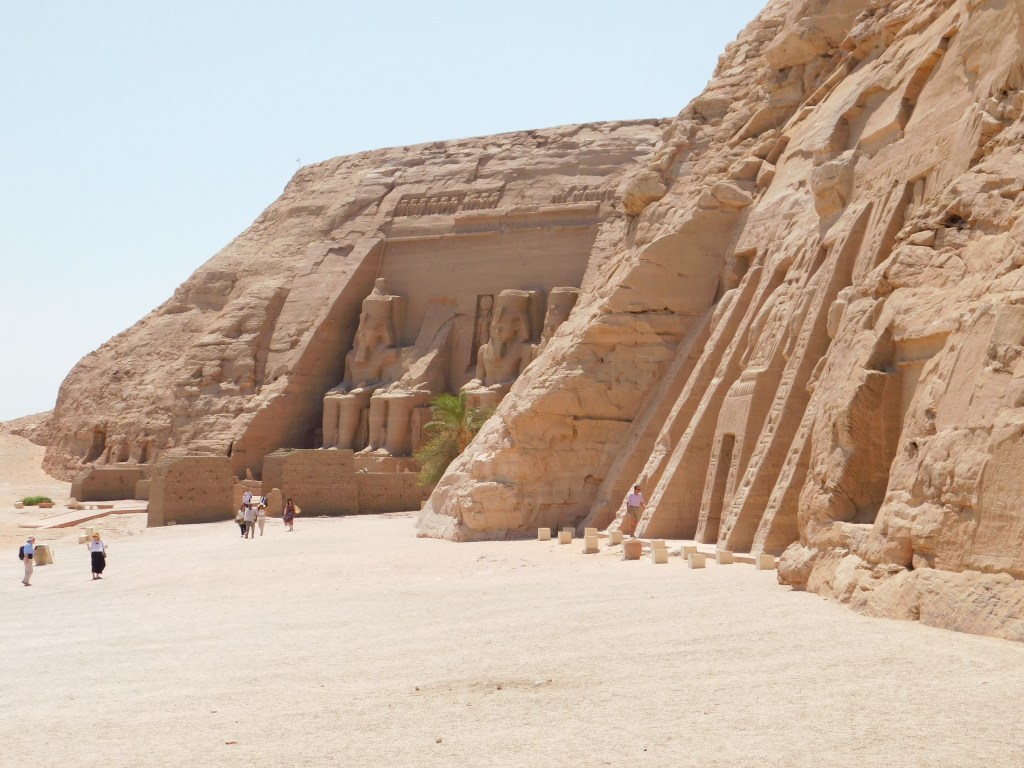
Entrance to the Great Temple of Abu Simbel, built by Ramses II.

These statues are 66 feet tall. They were moved exactly as they laid originally at the bottom of the mountain. So, the statue that has the head toppled off was left in it’s original state and not repaired when they moved the temples.

The temples fell into disuse for thousands of years and got covered and filled with sand. In 1813 Swiss journalist Jean-Louis Bruckhardt found just the very top part of the frieze of the temple above the sand line. He realized there must be something important below and told the world about it. In 1817 the Italian explorer Giovanni Belzoni was able to excavate the entrance and get into the temples.

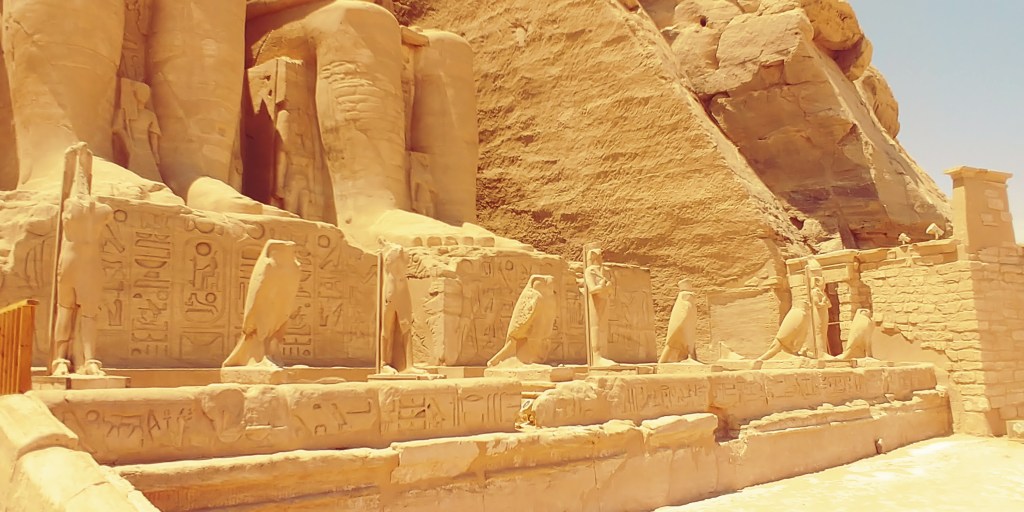
Randy and his buddy, Ramses II.
Line of owls at the entrance to the temple.

After gawking at the outside, it was time to head inside this amazing temple.
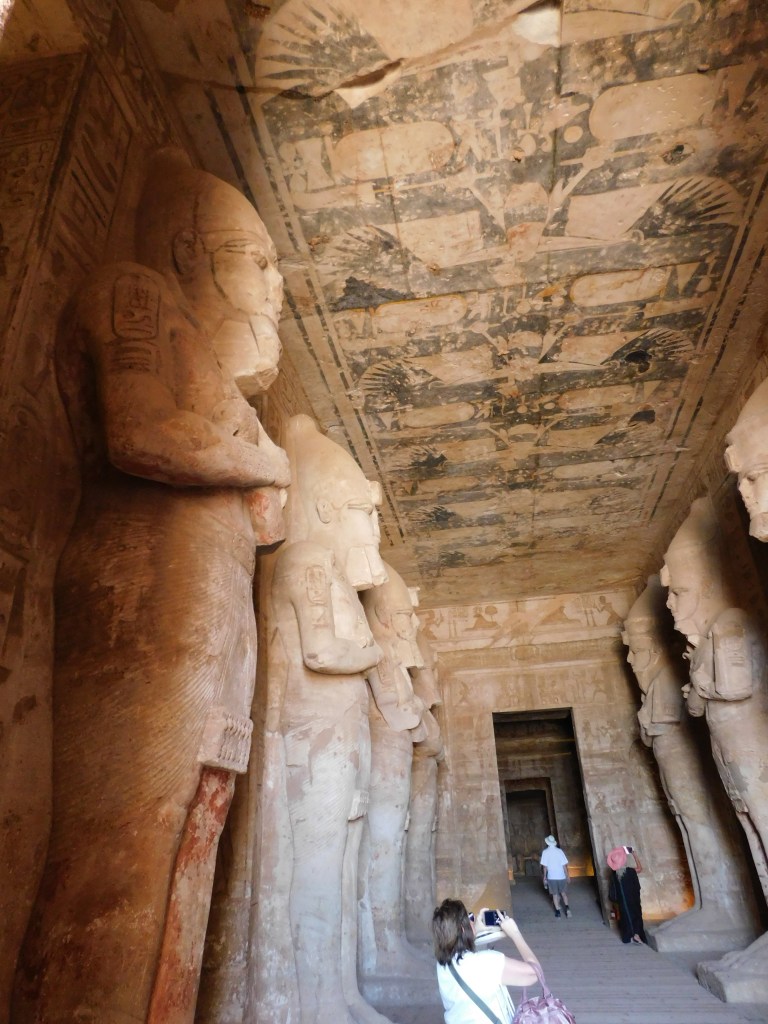
Entrance to the Great Temple.
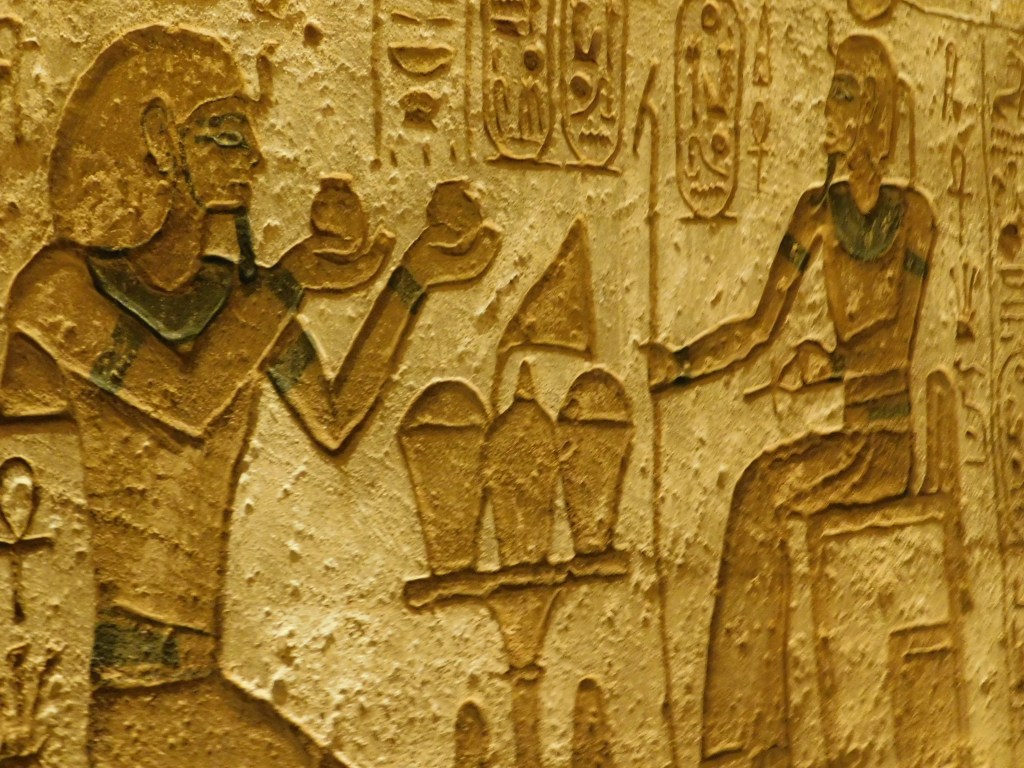
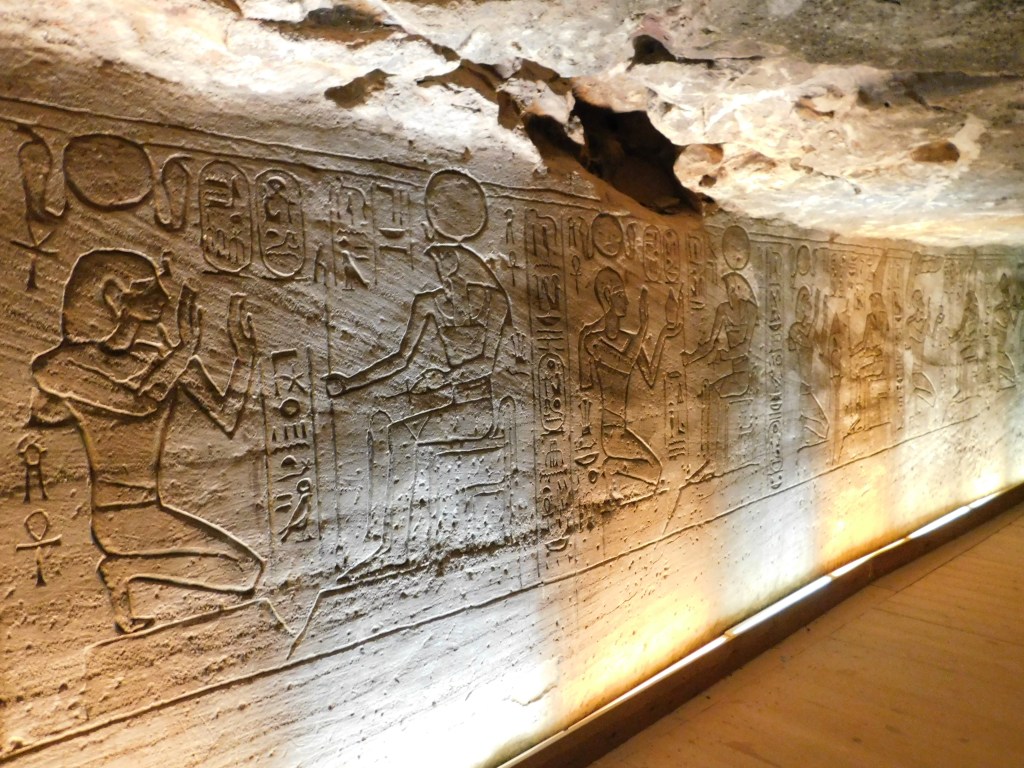
Example of wall carvings throughout the temple. This scene is from the chariot battle.
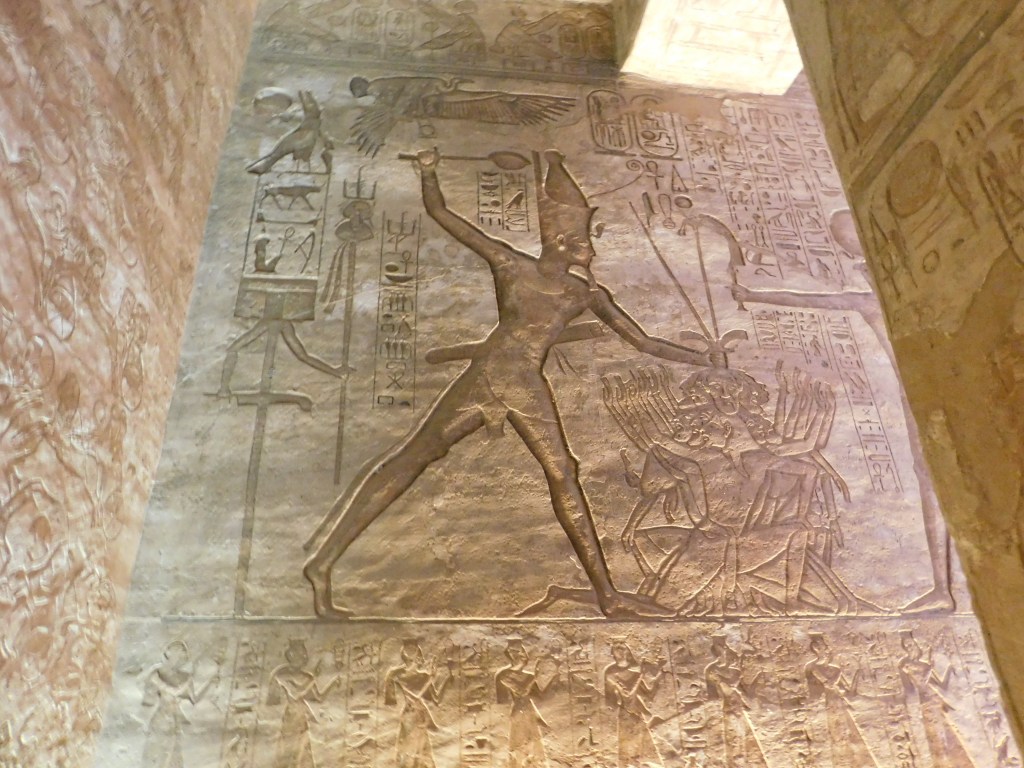
Ramses II striking down an enemy soldier.
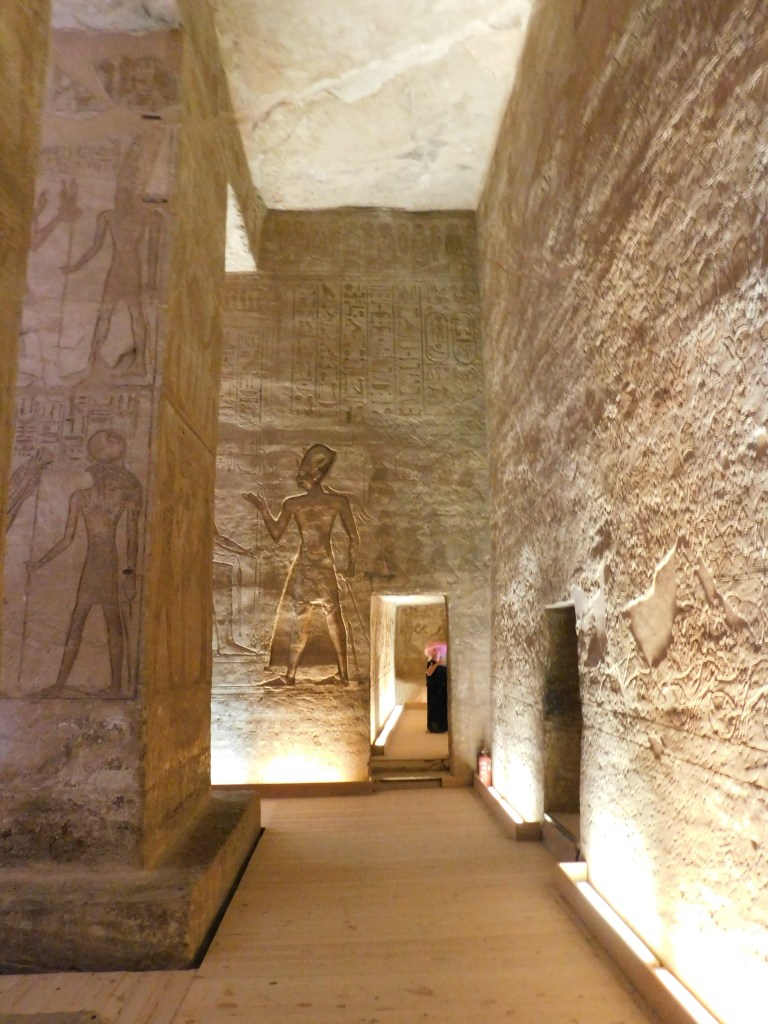
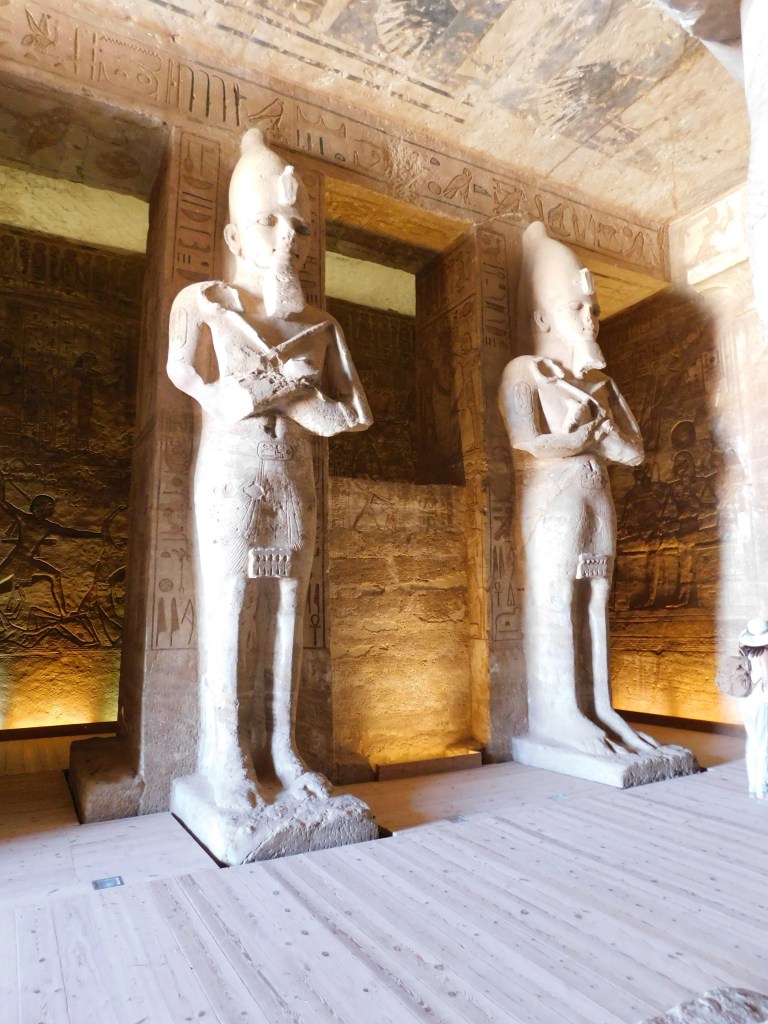
Hallway into some of the many rooms in the temple.
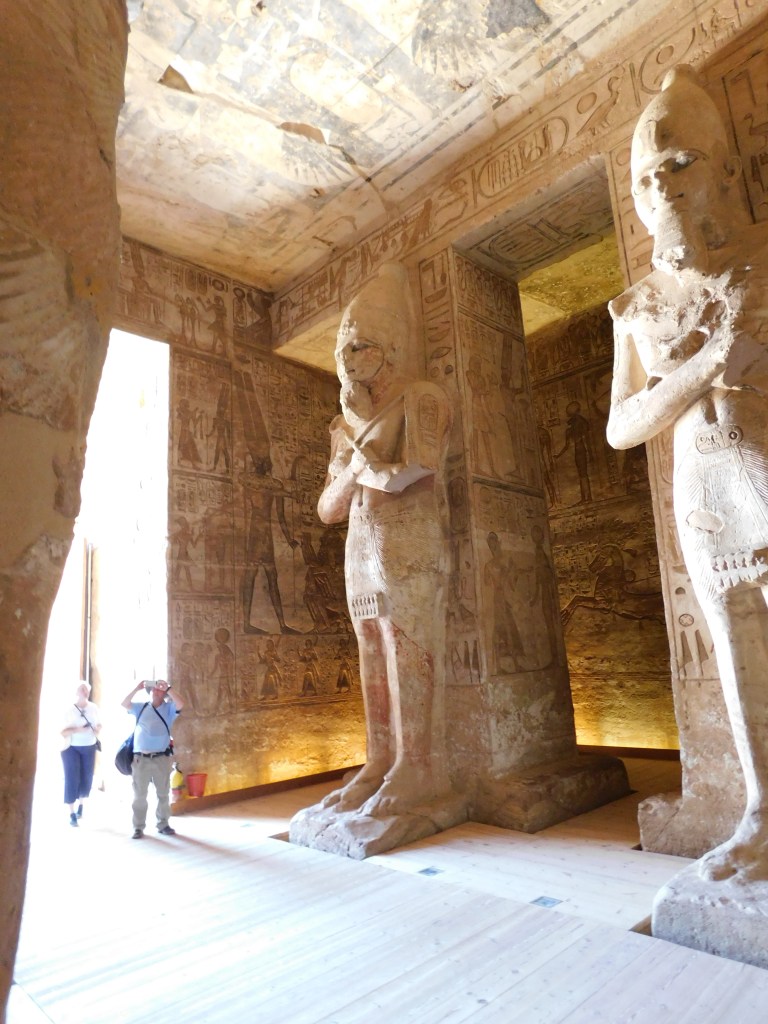
More statues of Ramses II. This guy really was a self promoter.
Another room inside the temple.
Carving of Ramses II and Queen Nefertari, his favorite wife. He had over 100 wives and concubines and 200 children. His Christmas gift list must have been awfully long!
Another temple side room.
Dinner time.
Yet another side room.

Remember, all of this was originally 250 feet below, on the bank of the Nile River. It was cut up, disassembled and reassembled up here. It is virtually impossible to see any joint or cut lines throughout the temple. Absolutely amazing. The temples were moved by an international team of archaeologists and heavy equipment operators through UNESCO at a cost of $40,000,000 between 1964 and 1968. The blocks were cut up into 20 ton portions and moved up the mountain.

The other temple is dedicated to Queen Nefetari. Although not a big as RamsesII temple, it is still very impressive, especially when you consider she was just a Queen, not a Pharaoh or ruler.
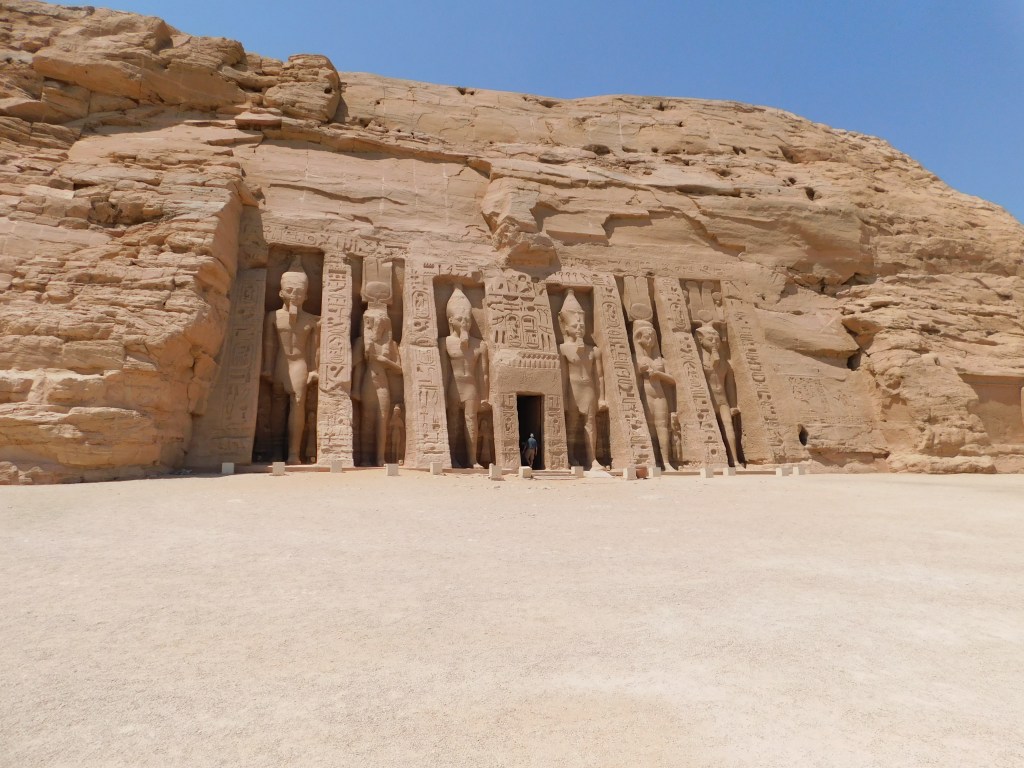
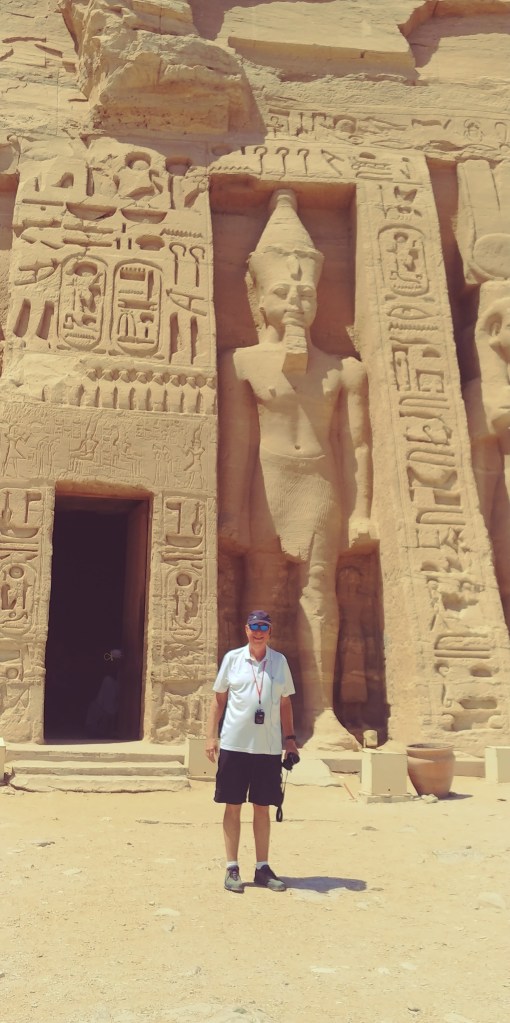
Exterior of Queen Nefertari temple.
Randy outside Queen Nefertari temple.
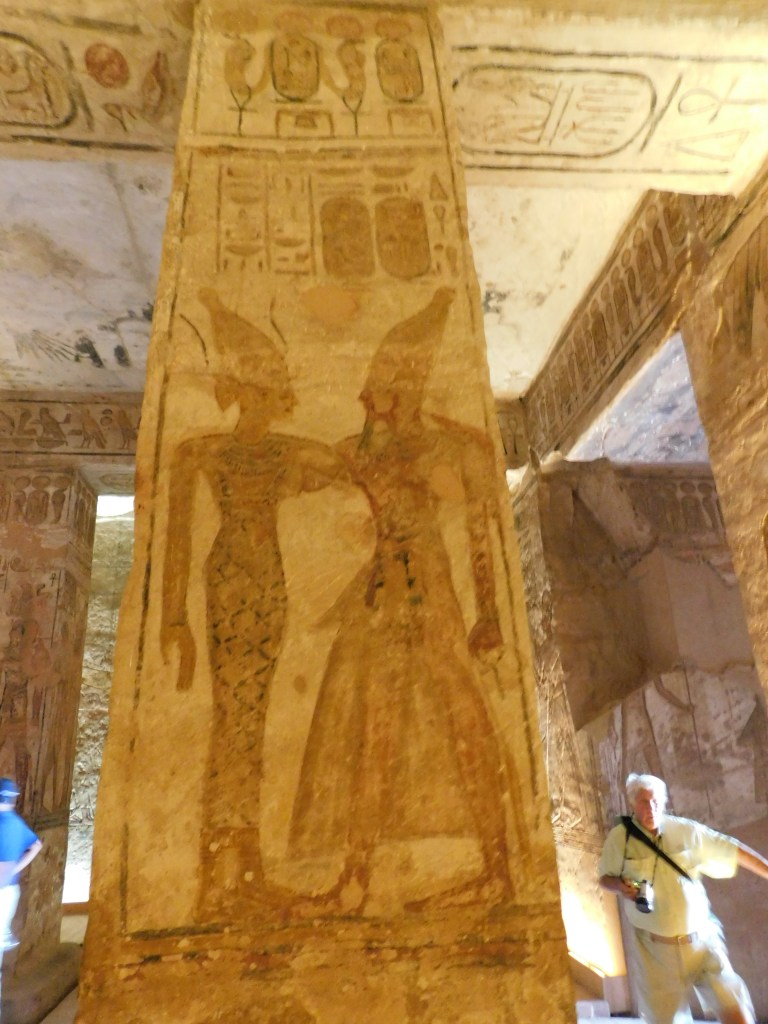
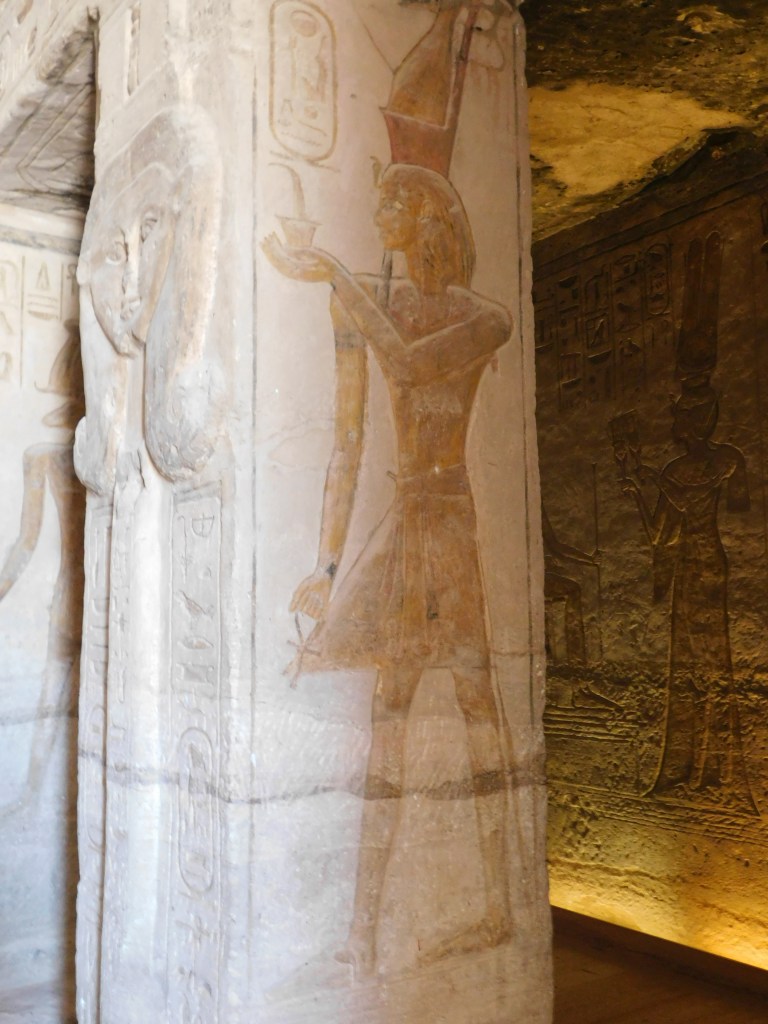
Column carving at at the temple entrance.
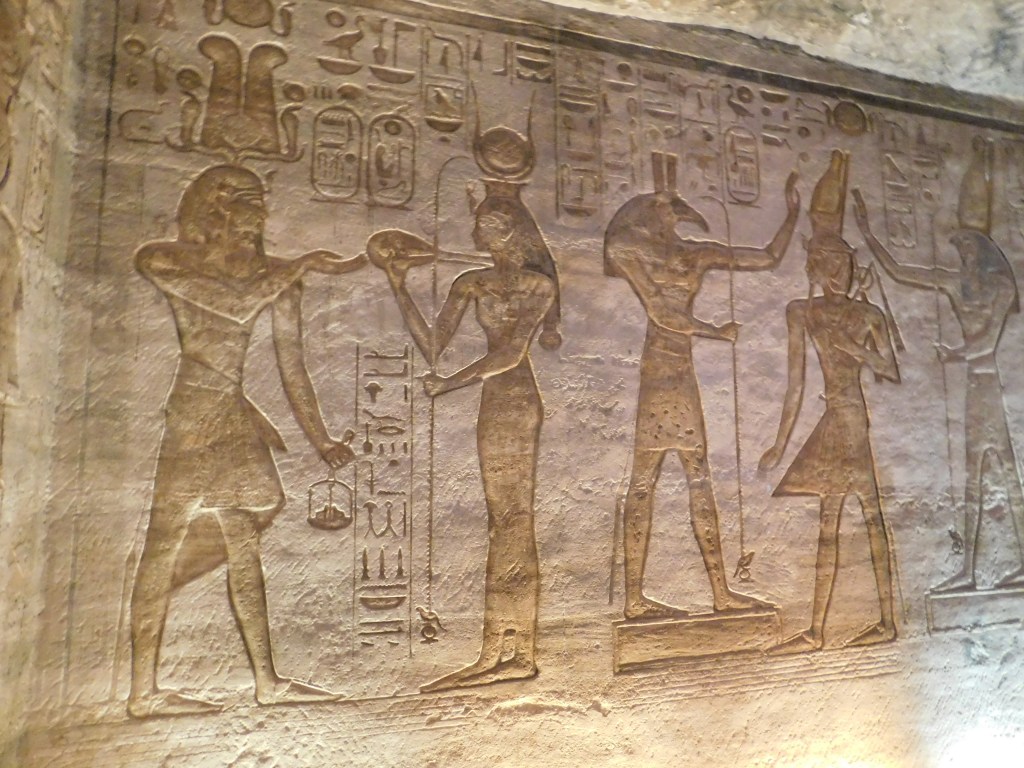
Ramses II and Nefertari hanging out together.
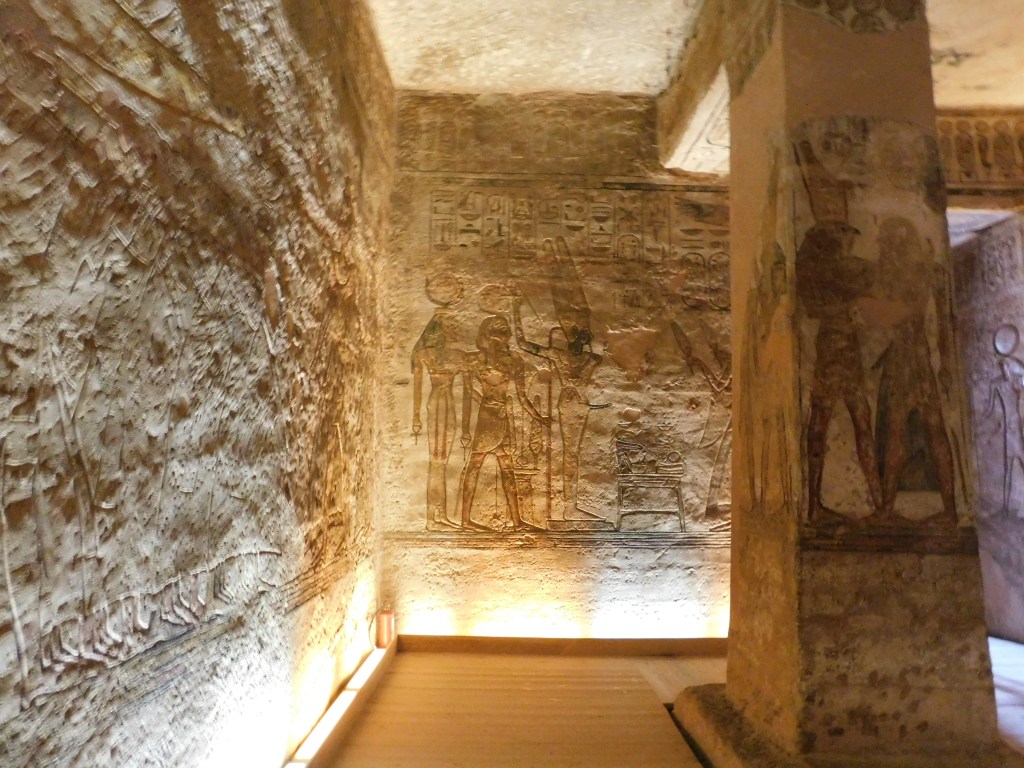
Temple interior room.
Interior passageway.

We left the Queen Nefertari temple and had to head back to the bus to the airport. Here is the view, leaving the site, of both temples.
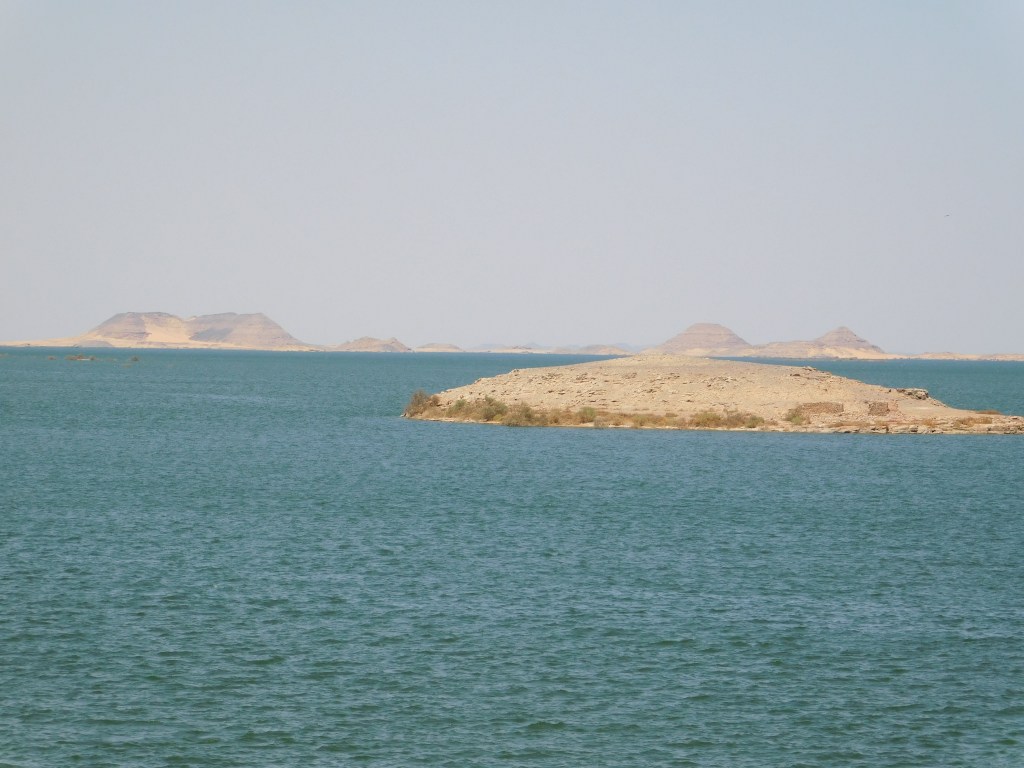
Here is the view of the artificial Lake Nassar from atop the temple mountain. That island looking thing is actually the top of a mountain from before they flooded the valley. Lake Nassar is over 500 feet deep in spots. It also is full of Egyptian crocodiles, which prohibits the scuba divers and swimmers of the world from going into the lake.
Speaking of crocodiles, the Egyptians made the God Sobek in the image of a crocodile. They considered them very important in their religion.

We jumped back on the plane to Aswan and then on the bus back to the Viking Antares. We then pushed off, heading north to Kom Ombo. Along the way we saw a waterfront temple lit up for the night.
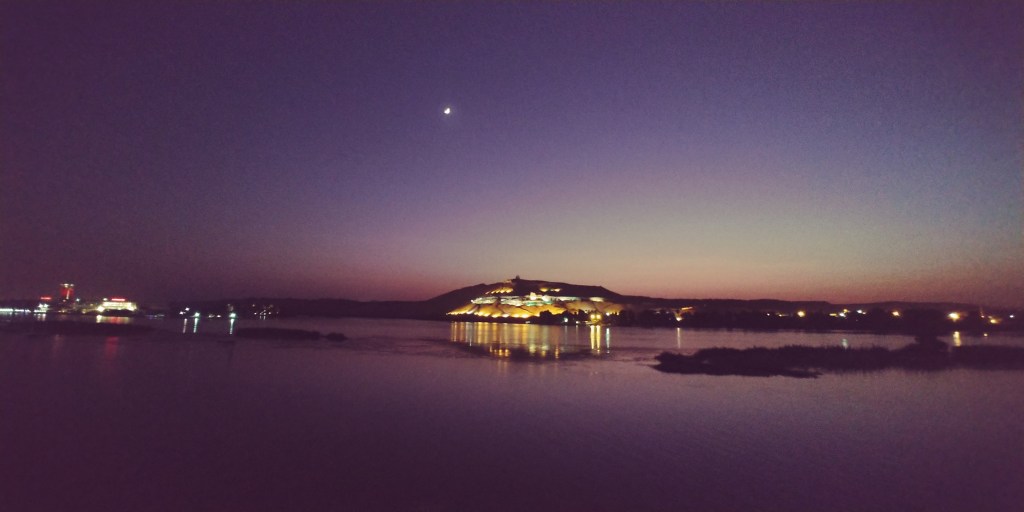
Docked on the Nile in Aswan on the Nile. The Philae Temple lit up in the distance.
Party boat around the Philae Temple on the Nile.

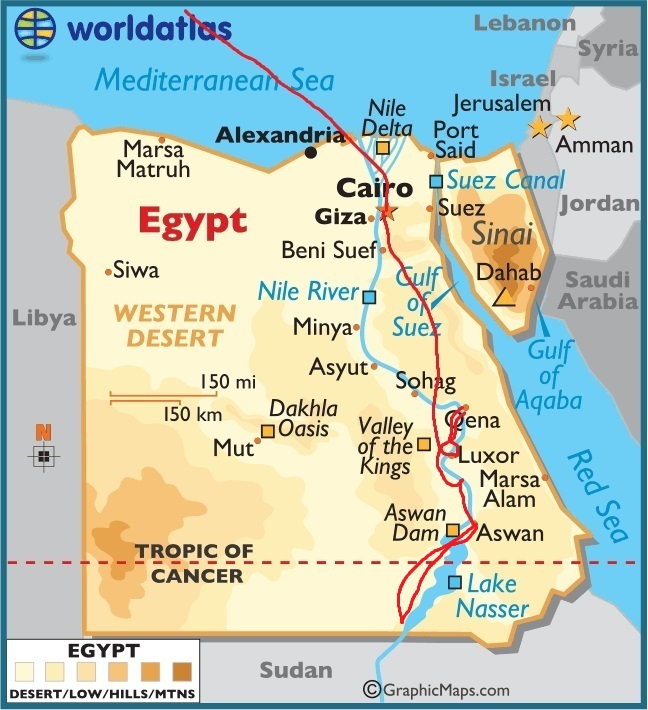
Map progress – Esna, Egytp to Aswan, Egypt by boat. Aswan, Egypt to Abu Sumbel, and back, by plane.
Esna, Egypt – the Ancient Temple of Khnum and town market place.

August 25 – September 5, 2019

After boating through the night from Qena, we arrive in Esna, Egypt in the early morning. During the night, we went through a lock to take us from the lower part of the Nile to the higher part, in front of the Aswam Dam. While we slept through this part, we got to see the lock on the way back to Luxor, a few days later.

We start off early in the morning and head out to the market place to support the local economy.

The Temple of Khnum is right next to the market place, unfortunately we can not take pictures. We could only sneak one picture from outside the grounds.

The Temple of Khnum.

After the temple and market place it was back on the Viking Antares to continue our journey. This part of the trip featured a very interesting section of the Nile that had tombs and recently discovered quarries and housing for the workers that built the pyramids up in Giza.

After viewing the Al Kab Tombs, we got a chance to visit the captain on the bridge of the Viking Antares. The Antares is not owned by Viking, but is leased through an Egyptian shipping company. The captain is a 40 year veteran of navigating the tricky waters of the Nile River.

That night on the Viking Antares featured an Egyptian dress up theme. Most people bought some genuine Egyptian clothing at the market or on board and paraded around the ship like the locals!

Modern day Ramses II and Nefertari!

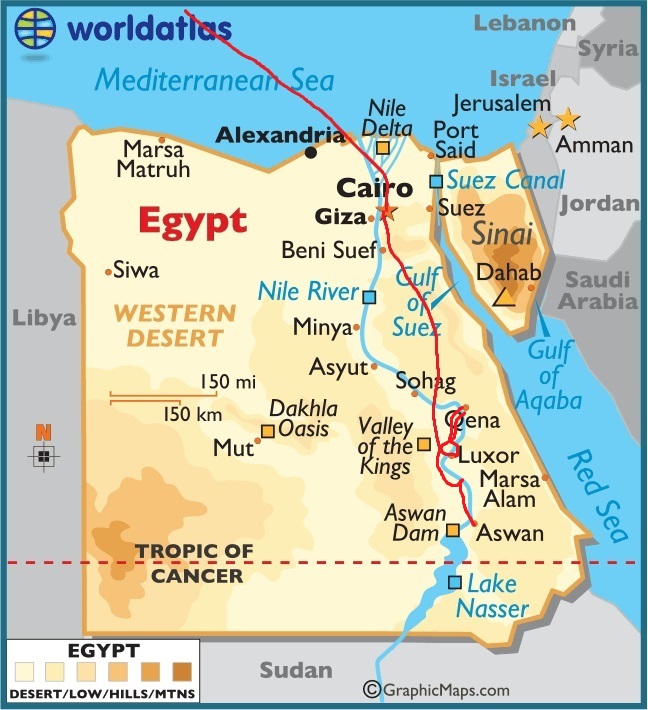
Map progress – Qena, Egypt to Esna, Egypt by boat.

Qena, Egypt – the Dendera Temple.

August 25 – September 5, 2019

We started our journey on the Viking Antares by heading north from Luxor, down the Nile (down as the river flows south to north, unlike most rivers that flow north to south) to the town of Qena and the Dendera Temple.

After the great sunset, it was off to dinner and a show. We saw a slightly overweight belly dancer and a Whirling Dervish. What might you ask, is a Whirling Dervish? It is a male dancer that basically keeps spinning around for quite a long time. He has costumes that change and provide some really interesting effects as he tries to keep from getting dizzy and falling down.

During the night, we docked in Qena and early the next morning it was back on the bus to head out to the Dendera Temple. We pick up an armed escort (yeah, that makes us feel real safe) and head over the Nile to the Dendera Temple.

The Dendera Temple is smaller than the Karnak and Luxor Temples, but it is almost totally complete. The roofs are still there (we even walked on them) and there are many columns and rooms throughout the temple. The site has been used for the last 4,500 years. The existing buildings were built by Pharaoh Nectanebo II 2,500 years ago. The buildings are so well maintained that people actually lived in side them for hundreds of years. The religious aspect of the buildings had been lost over the centuries, so the nomadic peoples just took advantage of the sturdy structures to live in. They burned fires inside for hundreds of years and blackened the insides very dramatically. However, this soot actually helped protect the carvings and paint. The Egyptian government started to restore the interior by first kicking out the inhabitants about 100 years ago. Then they dug out the sand and debris that had accumulated on the ground levels over the centuries. Then they found a way to remove the soot while not removing the original paint colors. The result is a pretty spectacular piece of history that looks very similiar to what it did when it was originally built 2,500 years ago.

After exploring the various rooms inside the temple, it was time to climb the dark, creepy, narrow, stairs to get up to the rooftop.

Once again, it is back to the Viking Antares and time to shove off to our next destination, Esna, to see the Ancient Temple of Esna.

Map progress – Luxor, Egypt to Qena, Egypt by boat.

Luxor, Egypt – the Valley of the Kings

August 25 – Sept. 5, 2019

After the amazing temples at Karnak and Luxor, it was back on the bus to head out to the tomb of Queen Hatshepsut and the Valley of the Kings. She was the second confirmed female Pharaoh in Egyptian history and was quite successful and powerful. She grabbed the throne after her husband Thutmose II died. She out maneuvered her step son Thutmose III and ruled for more than 20 years. After she died, he did his best to destroy her memory by defacing and destroying what ever monuments he could that she had created.

After visiting the Queen Hatshepsut tomb, it was back into the desert and onto the Valley of the Kings. A few thousand years ago the Pharaohs figured out that if you build a really big pyramid as your funeral spot, it just tells the world that someone important is buried here, and oh by the way, come break in and steal my stuff.

So, they got a little smarter and started to carve burial chambers into the mountains in what became known as the Valley of the Kings. This is where Howard Carter found the tomb of Tutankamon in 1922. This was a mere 3,300 years after he was buried. So, the theory worked pretty good. The experts are certain there are still many graves to be uncovered in this area.

The area is way out in the desert with a pyramid shaped mountain in the back ground. This way they thought they were still following the pyramid tradition from previous dynasties.

Entrance to the Valley of the Kings with the pyramid shaped mountain in the background.
Trams to get us up into the Valley of the Kings.

We were able to see 3 tombs of the many that exist in the Valley of the Kings. They limit the number of people allowed into the tombs to 150 per day to limit the impact on the area. Luckily, our Viking River Cruise crew had an inside track (meaning he knew who to bribe) to get us tickets. We saw the tombs of Ramses IX, Ramses III, and Queen Nefertari. I paid an extra 10 Egyptian pounds and also saw King Tutankamon’s tomb.

The first tomb we saw was Ramses IX. All of the tombs, except Tut’s, featured long passages cut down into the mountain with several rooms to hold the coffin and the items to help them on their journey to the afterlife.

Signage to Ramses IX tomb and tomb diagram. Notice the open date – since antiquity. So, it has been open for hundreds, or thousands, of years.
Entrance to Ramses IX tomb.
Paintings and carvings on the tomb wall. Those colors are over 3,500 years old.
Tomb room of Ramses IX.

Tut’s tomb was tiny compared to the other Pharaoh’s tombs. The reason being that he died very young, way before they had time to build him a normal, large tomb. They actually took an existing tomb that was being prepared for a nobleman that hadn’t died yet and stuck him in there.

Entrance to King Tut’s tomb. The Number 62 signifies that this was the 62nd tomb found and identified.
Walls and door to the treasury room in King Tut’s tomb.
Burial room of King Tut. It is very small compared to the other Pharaoh’s tombs in the area because he died before they could build him a proper tomb.
The actual mummy of King Tut. They took the possessions in the tomb to the Egyptian Museum in Cairo, but left the mummy in a sealed chamber in his tomb.

Next it was off the Ramses III tomb. He got really smart and put in a burial chamber that was so big that none of the thieves (or archeaologists) over the next 3,000 years could get it out of the tomb.

Signage and diagram of the tomb of Ramses III.
Entrance to Ramses III tomb.
Exquisite painting and carvings on Ramses III walls and ceilings, over 3,000 years old.
The still intact giant burial chamber of Ramses III.
Treasure rooms of the main burial chamber of Ramses III.
Randy in front of the burial chamber.
Amazing wall carvings and paintings, still so preserved after thousands of years.

After these 3 tombs, it was on to the best of them all. The tomb of Queen Nefertari was discovered in 1904. It had been totally undisturbed and remains the best example of the quality and preservation of any of the Egyptian tombs. The tomb is over 3,500 years old and looks like it was constructed just a mere hundred years ago or so.

Amazing carvings and paint colors.
Ramses II and his favorite wife, Nefertari.
The passageway down into the burial chamber of Nefertari.
Queen Nefertari on the throne.
An inner room to the tomb.

After a truly amazing day, it was back to the ship to head on down the river to our next stop.

Map progress – none, still in Luxor.

Luxor, Egypt – the Temples of Karnak and Luxor.

August 25 – Sept. 5, 2019

After our last night in Cario, we head out to the Cairo airport via bus to board a charter flight to Luxor, Egypt. We are heading south to meet up with our ship, the Viking Antares, to begin the river cruise portion of our trip.

Cairo Airport, typical sight of guys with guns everywhere.
Our ride to Luxor. A private charter jet from a local transportation service. Pretty cool.
View of Cairo as we took off. That is the Nile River on top, right below a whole lot of desert.

After about an hour flight we arrive in Luxor and are bused to the ship.

After we settle in the Viking Antares, we head out to the Karnak and Luxor Temples. These temples are two temples in the same general location. The first is the Temple of Karnak. The Temple of Luxor is a separate temple, nearby.

These temples were built up over time and through various Egyptian dynasties. Each successive Pharaoh would add a section that would demonstrate his accomplishments and allegiance to his gods.

Columns inside the Temple of Karnak
Hieroglyphics on a column in the Temple of Karnak.
Original section of ceiling that still remains. The whole Temple had them as it’s roof when the structure was intact.
Randy hanging out with the Pharaohs. Ooops, crossed arms means you’re dead.

As big as the Temple of Karnak is, they still have thousands of more pieces that they are trying to reassemble.

Acres and acres of pieces they are still putting back together.

We then take a short bus ride over to the Temple of Luxor. It is connected to the Temple of Karnak by a road lined with statues of small Sphinxes. It is much larger and better preserved than the Temple of Karnak. It features a large addition done by Ramses II.

After a truly fascinating day, it was back to the Viking Antares for some dinner and drinks.

Map progress – Cairo, Egypt to Luxor, Egypt by plane. Boarded the Viking Antares on the Nile River in Luxor.

Cairo, Egypt – the Egyptian Museum and the Khan el-Khalili Market.

August 25 – September 5, 2019

After our great day with the Pyramids and the Sphinx, we stayed in Cairo to see the Egyptian Museum and some local sights. As mentioned before, Cairo is quite a mess. The traffic is un-driveable for anyone other than a local. The city is dirty, full of police and security guards, metal detectors, and pushy vendors all over the place. However, it has it’s bright spots if you can get there with your wallet intact, and not run over or into by a crazy Egyptian driver.

Our Viking River Cruise provided great transportation, security, and tour guides to accomplish this goal. Remember, we just drove around Eastern Europe for 2 months, on our own, in a rental car, through former Communist countries and had no issues what so ever. I would not even consider doing that in Egypt.

We load up on the bus again and head directly into Cairo. We are off to see the Citadel section of town which includes the Mosque of Mohamed Ali (not the boxer, the one from a few hundred years ago). Along the way we get a very accurate view of the condition of Cairo and how the people live. It appears to be worse than Havana, Cuba, which I didn’t think was possible. The buildings are not finished and crumbling (that is a tax issue usually), full of debris, and feature little sidewalk shops that are usually not even open.

After our short bus ride, we pull into the Mosque of Mohamed Ali, which also housed the former complex of a palace of King Faroukm the last Egyptian king.

This city landmark was built between the years of 1830 – 1848. It is an active mosque and quite a beautiful building.

The Mosque of Mohamed Ali.
Mosque ceiling and lighting.
Mosque decorative wall.

The Mosque grounds also include a former palace of King Farouk and an outstanding view of Cairo.

After visiting the Mosque, we went to the Citadel section of Cairo which consists of many, very old, mosques and historical buildings.

After the Citadel we went on to the Cairo Egyptian Museum. This is an amazing building that houses some of Egypt’s most precious artifacts, including the golden mask of Tutenkamen and the mummy of Ramses II.

King Tut’s golden death mask.
King Tut’s chariot, found in his tomb.
Tut’s golden casket.
Tut’s burial chamber. His casket and mummy were inside this. It had 4 different chambers inside it, like a Russian nesting doll.
One of hundreds of statues in the museum.
Replica of the Rosetta Stone.
Typical example of Egyptian Hieroglyphics, with the God Horus at the top.
A mummy casket.
One of many, many, floors in this fantastic museum.

One special part of the museum featured the mummies of several pharaohs, including Ramses II, the most powerful of all of them. It also had the mummy of Queen Nefertari, Ramses II favorite wife. Unfortunately, they did not allow pictures in this part of the museum.

I was quite amused to see the actual mummy of Ramses II. He is depicted in all of the temples and in his tomb as a great warrior. He is shown mowing down enemies with his sword and shooting them down from far away with his great long bow. The thing is, he could not have been taller than 4 foot 6 inches and could not have weighed more than 80 – 90 pounds. I don’t think he would have stood much of a chance on a battlefield in modern times.

After returning to the hotel, Andrea and I went out and did a little dress shopping for her. The dress I bought her a few days ago did not fit, so we went to the same shop to try to exchange it. The old guy I dealt with was not there, but his son was. We exchanged the dress, for an additional 100 Egyptian pounds ( $17 ) of course, and made our way back to the hotel across the heavy traffic and all the crazy drivers, safe and sound.

Later that evening it was off to see the Khan el-Khalili market and enjoy an authentic Egyptian dinner at a local restaurant. The night time bus ride was quite entertaining, especially through the very crowded market.

Map progress – none, still in Cairo.

Cairo, Egypt – the Pyramids and the Sphinx

August 25 – September 5, 2019

The next day in Cairo was one of the big ones for our trip. We headed out on the Viking bus from the Ritz Carlton Hotel in Cairo to Giza and to see the Pyramids and the Sphinx. We started off with some smaller pyramids before we hit the main ones in the town known as Memphis (not Elivis Presley’s home in Tennessee).

The bus ride over the Memphis was quite an eye opener for the city of Cairo and the surrounding area. They are old, beat up, and quite filthy. We had gotten somewhat used to seeing horse and donkey carts in Eastern Europe, but Egypt really still depends on these a lot, even today. Also, once you get out of Cairo, there is trash everywhere. The waste management system outside of Cairo does not work, so people just through their trash out into the streets and the irrigation canals. It really is quite nasty and a health hazard.

We arrived at the Step Pyramid and tomb, way out in the desert. The Step Pyramid was the first large pyramid built by the Egyptians. It was constructed in several stages, beginning in 2667 BC. It was built by and for the Pharaoh Djoser. We saw inside the tomb, the pyramid itself and the surrounding courtyard.

The great explorer in front of the Step Pyramid.

After Memphis, it was off to the big time. We went to Giza to see the Pyramids and the Sphinx. This was a major bucket list item for Randy. Andrea had seen them many years ago on a school trip from England.

View of the Pyramids from our bus in Giza.

We got to the entrance of the Pyramids. They are literally next to the City of Giza. While they used to be by themselves hundreds and thousands of years ago, today the city is built right up to the Sphinx and the entrance to the pyramids.

You got’s to buy your ticket, lady.

Once inside the gate, we got bused into the complex and straight into one of the highlights of the trip. We got to ride camels in the pyramid area. One of the Goodell family thoroughly enjoyed the experience. The other, not so much. See if you can figure out which is which from the next video.

The two new camel pro’s!

After surviving the camel ride, it was off the see the pyramids up close and personal.

The Ace Camel Jockey on his turf. The Menkaure Pyramid is on the left, the Great Pyramid in the middle, and the Khafre Pyramid on the right. Abdul the camel is resting.

We jump back on the bus and drive down to the base of the Khafre Pyramid. We can walk up to it, touch, and really experience the grandeur of the structure and the other pyramids.

Looking west at the Great Pyramid from the base of the Khafre Pyramid.
The camel jockey at the base of the Khafre Pyramid. Look at the size of those blocks.
This was our security guard, complete with machine pistol, that accompanied us on the tour. He was very alert and was not messing around. Definitely not a Rent a Cop.
The Great Pyramid.

Next it was back on the bus to head off to see the Sphinx.

The Sphinx was amazing. Not just the size of it, but the detail and structure. The fact that it is over 4,500 years old just adds to the mystique.

The Spinx.
The Spinx complex with the 3 great pyramids in the background.
Camels heading out to the desert, actually a surprisingly common site.

All in all, it was a fantastic day. We saw sights that I have only seen in pictures and on TV before that I have always wanted to see in person. They did not disappoint. While Cairo itself leaves a lot to be desired, the Egyptian people have hung onto their cash cow by preserving their cultural and archaeological sites for future generations.

Map progress – none, still in Cairo.

Cairo, Egypt – the Viking River Cruise beginning.

August 25 – September 5, 2019

Our flight from Athens, Greece to Cairo, Egypt was uneventful, which is always a good thing. Our hotel, the Ritz Carlton, had arranged for a taxi driver to pick us up at the airport arrivals section. His sign said Mr. Andrea Goodell, so we found him very easily. Andrea was not happy.

The drive into town was an experience. These Egyptian drivers are nuts! Anywhere there is space on the road, they will take it. They don’t even bother marking the lanes any more, because these guys make up their own lanes. Where Bucharest parked cars everywhere, these folks drive any where they can fit a vehicle into.

Our driver gets us to the hotel safe and sound. Then the real fun begins. The whole entrance to the hotel is blocked off and has armed guards, like a military base. They have a bomb sniffing dog, they do the mirror thing underneath the car, make the driver open the trunk, and they finally let us in. This is private hotel security doing this, not the police.

We get scanned and have to go through the metal detector each and every time we go into the hotel.

It’s not only the hotel that has an extreme amount of security. The entire city is full of police and army checkpoints, armed guards, and watch towers.

Typical checkpoint in Cairo. They are EVERYWHERE!

We settle into the luxurious hotel and head down to the restaurant to get some drinks and lunch.

The Nile Ritz Carlton.
Poolside in Cairo.

We have arrived in Cairo on Sunday, a day earlier than our official Viking River Cruise check in date. We wanted a little time cushion as we were traveling on our own and not as part of the prearranged Viking air flights. The next day, Monday, was basically a free day for us. Andrea decided to investigate the pool area while I decided to go explore a bit. Our actual Nile River cruise didn’t start for a few days in Luxor, so I wanted to find a way to sail on the Nile in Cairo. The concierge at the Ritz gave me the name of a local tourist boat operator and told me to “go and negotiate your own price with him”. OK, not very formal arrangements, but what the heck. Let’s give it a try. Off I go to find the Dok Dok boat dock on the Nile.

The Dok Dok dock is about a kilometer down the river, just as she said. I talk to the head guy and work out a price for a private sail boat ride. It costs me 250 Egyptian pounds, about $15.00, for a 45 minute private sail boat ride on the Nile. Pretty cool.

On the way back to the hotel, I tried to sneak a shot of a security checkpoint outside of what turned out to be the American Embassy. The soldiers were not happy with me.

The soldier yelling at me was probably American from the way he spoke English. I was way on the other side of the street and he saw me with the camera almost immediately. After I stopped filming he told me not to take any pictures in this area. He was pretty cool about it, but definitely not kidding around.

On the way back to the hotel I went off the main street and found a little dress shop and bought an Egyptian dress for Andrea. Walking back to the hotel, I was trying to cross the road and a young guy told me to go down under the underpass and then up to the main road. I thanked him, but then he started to walk with me, telling me he was a student, he loved Americans, and then tried to get me into a building so he could “give me his business card”. I just kept walking as he went into the building which surprised him. When I made the turn I saw him watching me from the building entrance. Was he just trying to get me to buy something, or was he really getting a business card? Who knows? All I know is I’m not letting some stranger talk me into going somewhere I don’t want to go.

Back at the hotel, we got some good shots from our room of the Nile during the afternoon and at night. At night it really is quite pretty as they light everything up. The down side is all those pretty lights are clubs and party boats. They played music until

2 AM which was a real pain in the butt when we were trying to sleep.

All in all, a fun first day in Cairo. The most dangerous part was crossing the darn road in front of the hotel, 6 lanes of busy traffic. There are no cross walks or traffic lights. You just have to wait for a break or work your way through the traffic. After the little old lady and the guy with the limp crossed the road before I did, I figured you just gotta go for it. Which I finally did and made it.

Map progress – Athens, Greece to Cairo, Egypt via airplane. We are now in the continent of Africa. The first time for me, second time for Andrea. One little point about my first time in Egypt. After we landed I admitted to Andrea that although I knew Cairo was in a desert it was still quite strange to see nothing but sand surrounding Cairo. I guess I got used to seeing trees, lakes, grass and other green stuff on all of our other landings. Needless to say, I got the Andrea eye roll and sigh of resignation about her bumpkin husband. Hey, this is my first desert landing. What can I say?

Air Egypt flight starting from Athens over the Mediterranean Sea.
Air Egypt flight landing in Cairo.

Athens, Greece – the Parthenon and the Archeological Museum.

August 22 – 25, 2019

We flew from Bellgrade, Serbia to Athens, Greece with no issues. Turned in the rental car in Belgrade with no charges (we left it really dirty to cover any little scratches) and met up with our prearranged airport taxi exactly as planned. The taxi took us to the Palladian Hotel, which unfortunately, was not what we expected. As we have been in the heart of Athens several times before, we wanted to book a hotel on the outskirts of town and explore some different areas. We wanted kind of a resort hotel with a pool and lounging areas to kick back and take it easy. Somehow, we booked a little 14 room hotel right in the heart of Old Town across from the Parthenon. No pool, no lounging area, but right in the middle of all the action.

The room was tiny and ancient, but at least it had air conditioning. It was located right next to a square, which sounds really cool until you have to listen to the party crowd every night until about 2AM. Oh well, we just had to adjust our plans a bit.

It’s time for lunch, so might as well walk outside the hotel, take 20 steps, and eat at the great restaurant outside our second floor window.

Start lunch with drinks, of course.

As we are eating lunch, we notice a movie theater right across the street that is advertising “Once upon a time – in Hollywood”, the current Quentin Tarantino movie starring Brad Pit and Leonardo DeCaprio.

The movie is in the original English, with Greek subtitles. We buy some tickets for the 9:15 show and the lady says, “be sure you get here before 8:00 or you won’t get two seats together”. We get there at 7:45 and she is right. The theater is an outdoor theater on the second floor of a building. It holds about 200 people, serves drinks (the good stuff) and movie munchies, and fills up very quickly.

The outdoor theater, at dusk.
Drinks and popcorn, in front of the Parthenon, what a combination.
The eastern side of the Parthenon at night.

The concept of the movie is a Tarantino altered reality story about the Charles Manson gang murders of Sharon Tate and her friends in Hollywood in 1969. Andrea had no idea of the historical back story and got bored after about an hour, even with Brad Pit running around shirtless. She went back to the hotel and I finished up the movie, which I thought was OK. Not great, but definitely watchable. Over all, a fun, unusual way to spend an evening in Athens.

The next couple of days we spend doing the Acropolis, the Archeological museum, and some other interesting activities in the heart of Athens.

The Acropolis and Parthenon was about 8 blocks away. We tried to access the online ticket site sponsored by the Greek Government, but it did not work. We even went into the tourism office right outside the Parthenon entrance to try to avoid the lines and the Greek guy at the desk couldn’t even get it to work. No wonder their country is broke.

We brave the lines to get into the Acropolis and it is as amazing as we remember.

Theater of Herodes Atticus.
The Parthenon.
The Temple of Athena Nike.
View of Athens from the top of the Parthenon.

After wandering around the Parthenon and Acropolis, we buy tickets for the Hop On Hop Off bus. The same system we used in Budapest. We take a tour of the city on the top of the the double decker bus, ducking our heads as the trees go by.

That evening we head out to a restaurant in Glyfada, a suburb of Athens. Our good friend Chuck was in Athens last month for his brother’s wedding. He said the Balux Cafe would be a great place for us to visit. He was right. We had dinner on the beach on the Aegean Sea. Pretty spectacular location.

Sunset on the Aegean Sea.

The next day it was back on the Hop On Hop bus to head over to the Archaeological Museum. This is an amazing place. It is just full of artwork, statues, weapons, jewelry, and other items that they have collected from hundreds of years of excavations and purchases.

After a couple of fun days, it is time to head to the Athens airport to fly to Cairo to join our Viking River Cruise up the Nile River.

Map progress – Belgrade, Serbia to Athens, Greece by plane. Return flight to Athens in black.

Belgrade, Serbia – End of the road trip.

August 19 – 22, 2019

We drive from Craiova, Romania to Belgrade, Serbia to return the rental car and begin the next phase of the trip. The road trip through Eastern Europe is about over. Time to fly from Belgrade to Athens to Cairo to begin the Viking River Cruise down the Nile River in Egypt. But, of course, we had a few surprises along the way, even on this last leg of our trip.

When we originally planned the road trip, we wanted to visit Bulgaria a bit. However, when we picked up the rental car in Belgrade back in June, the rental agent was very adamant that we not go into Bulgaria. We looked into why he was so insistent on our not going there. It turns out that the relations between Serbia and Bulgaria are very strained. They are still having issues from the war in the 1990’s and even current national relation issues. So, we decided not to tempt fate and stay out of Bulgaria. We didn’t want some angry Bulgarian doing something bad to our Serbian car.

Well, we thought we were going to stay out of Bulgaria. Turns out, the darn GPS got us again. There is one tiny tip of Bulgaria that juts up between Romania and Serbia. Sure enough, the GPS routed us right through that tip, even though we thought we had set up the route to go around it. It was the same old story, ‘ well, we just left Romania, hello Serbia. Oops, hello Bulgaria’.

Out of Romaina, into Bulgaria by mistake.

Bulgaria requires the road vignette also. So, we buy a 7 day vignette like good little American tourists, even though we know we are just going to be in the country less than an hour. It’s a good thing that we did. As we left Bulgaria to finally get into Serbia, the Bulgarian border patrol was very insistent on checking everyone to see if they had purchased the vignette, after getting through the initial passport check. A lot of people had not. We had a bit of a scare when we realized the first passport guy had forgotten to return the vignette to us when he did the passport check. Andrea went scrambling back to get it as he was heading out to find her, to return it. The vignette guy then grudgingly let us go and started to hassle some poor Romanian guy that had not bought the vignette like we did. We just hightailed it out of there into Serbia.

We finally arrived at the Garni Hotel D10 in Belgrade, where we had stayed when we first flew into Belgrade back in June. Our buddy Vladimir remembered us and we got reacquainted with the rest of the staff. It really is a nice little hotel. Just 13 rooms, but very modern with a great staff.

The bar is open 24 hours a day at the Garni Hotel. A great feature!
Very cool mural outside the lobby.

The next day it is off to see the parts of Belgrade that we had not seen before. Andrea decided to repack bags and take it easy, so I was on my own for the day.

The first destination was Avala Tower. This is a major communications tower for Romania. It stands 204 meters tall on top of Avala Mountain, which has an elevation of 511 meters. It is situated about 25 kilometers west of Belgrade. The observation deck is at 122 meters from the base of the tower. So when you are in the observation deck you are 633 meters, or 2,076 feet high. FYI, the observation deck in the Freedom Tower in New York is 1,368 feet high. In other words, it is very high up there. The observation deck is not totally enclosed. There is a glass wall around it to keep you in, but the top is open air, with wire fencing. The wind just howls through the whole deck. It is a bit spooky to be up there on top of this narrow needle shaped structure.

Next, it is off to the Belgrade Aeronautical Museum. This museum is, appropriately enough, right next to the Belgrade Airport. Pretty easy to find. It has a good history of the Serbian and Yugoslavian aeronautics history from the manufacturing plants to the various fighters and transport planes they got from the Russians. I even saw Josip Tito’s (former President of Yugoslavia) personal plane that he got as a present from Nikita Krushchev (former President of the USSR). Kind of like his own Air Force 1.

After the Aeronautical Museum it was back to downtown Zemun to see the Gardos Tower. Zemun, where our great little hotel is located, is a suburb of Belgrade. However, hundreds of years ago it was it’s own little city with it’s own fortress, king, etc.. It is located right across the Danube River from Belgrade. The Gardos Tower and fortress are the remains of the old fortifications back when Zemun had to defend itself from the thundering herds of invaders that liked to ransack the various towns and castle of the area.

All in all, a fun day blasting around the suburbs of Belgrade.

To sum up the road trip; we drove about 9,000 kilometers (5,500 miles) in our 2 month road trip adventure. We had the one bump on the back bumper on the Fiat in Lithuania (that they did not catch), we had to turn in the Fiat because we wore it out, and had no damage (visible any way) on the Renault they gave us. Not bad for 5,500 miles of narrow roads with crazy European drivers and stupid pedestrians and horse buggies getting in our way through all of those countries.

Map progress – Craiova, Romania to Belgrade, Serbia, via Bulgaria by mistake.