Novi Sad, Serbia to Arad, Romania, what a pain!

August 1 -4, 2019

We were supposed to stay in Banja Luka, Bosnia and Herzegovina until August 2nd. But after seeing the Krupa Falls and the failed attempt to see the Etho Village, it was only about 2PM. As we had done all that we wanted to do in Banja Luka, we decided to leave early and get a jump on the supposed 6 hour drive we were going to have to do to get to Arad, Romania the next day. We pack up and are on the road about 3PM. It is a very good thing that we did that.

Bosnia and Herzegovina border with Serbia.

For starters, we had to back through the same stupid border of the Republic of Srpska that we had to come through a few days ago. That took about 2 1/2 hours out of our lives. We were heading for the town of Novi Sad in Serbia as a half way point to Arad, Romania.

As we are sitting in the car, inching our way towards the border crossings, all of a sudden Andrea pipes up “Why don’t they let trumpet players play here?”

I am totally confused by the question until she points out the sign to the left of us on the road.

No trumpets allowed.

After a couple of minutes, after I have finished laughing, I reply “Honeypie, that means you can’t honk your car horn in this area.”

Dead silence. End of conversation. Maybe a sheepish grin on her part.

We finally clear the border into Serbia.

Hey, nice sign at the border!

Our 3 hour drive turns into 7 hours with the border crossing and the usual road closures. We check into the Hotel Aleksandar in Novi Sad about 10PM. We are so glad we left a day early.

The next day we are off to Arad, Romania. Supposed to be a 2 1/2 hour drive. Yeah, right.

Serbian border.

Does this picture look familiar? Yeah, same situation, different border. Now we are leaving Serbia into Romania (more on that in a moment).

Out of Serbia.

After anther couple of hours, we get out of Serbia. The sign leaving Serbia is not quite as nice as the sign coming in. But, strangely enough, there was no sign welcoming us to Romania. Well, maybe they can’t afford signs.

We need to get a Highway Vignette so we immediately pull over as good little American tourists and buy a vignette. As we are going to be in Romania for 17 days, we have to pay 22 Euro for a month long vignette. OK, no big deal. However, we couldn’t figure out why they wouldn’t take our Romanian money. We wanted start using our cache of Romania bucks, but they refused. Huh, a little strange we thought.

As we are tooling along down the highway, we finally see a sign for Arad, but it has the RO on it indicating that it is in Romania. Hey, we’re supposed to be in Romania. Why do they need to tell you it is in Romania?

Well, avid reader, what would be a logical explanation for this situation? Come on, think hard. You got it, right?

Yep, we are not in Romania. Somehow the darn GPS routed us through Hungary. We just paid 22 Euro for a toll sticker that we are going to use for about 100 kilometers. Also, what does this mean? Yep, we have to cross through yet another border crossing.

Hungarian – Romanian border.

Finally getting closer. Up to the Romanian side.

The border crossing into Romania was the most intense we have had to date. They were searching every vehicle, including ours, that went through the border. They didn’t actually open our luggage or anything, but the cop did open up our bottles of water and smelled them to see it they were really liquor. They pulled a few people off to the side for a more vigorous search. Especially the trucks, campers, and boats.

They had a nice sign that said “Welcome to Romania”, but we missed taking the picture. So, here is the next best thing.

Once we pull off the highway to get into Arad, we stop at a gas station to buy gas and yet another 30 day vignette. The vignettes in Romania are sold through vending machines (at least in this gas station). There is no English version. Luckily the guy at the gas station was helping us in between helping customers. We had one final mistake and over paid for the sticker by about $5.00. It showed up as a credit on the bottom of our vignette. We asked him if we could get a refund, he said no. You can only use it as a credit in the machine (which also sold other mysterious stuff). So, Andrea tears off the credit and gives it to the guy. Hey, he tried to help us and we certainly will never use it. I hope he hits the lottery with it.

We finally pull into our Best Western Central hotel in Arad about 5:30 local time. There is a one hour time difference between Romania and Serbia, it goes ahead. Still, our 3 hour trip turned into 6 hours.

So, 13 hours for what we thought would be a 6 hour drive before we started. As I said, it is a good thing we left a day early. Those 3 border crossings were totally ridiculous.

We picked Arad as a good stopping off point to our next location in Transylvanian mountains. We knew there was not a lot to see here. We were not wrong.

City Hall in Arad. Number 1 tourist attraction.
Civic pride.
Evidently we just missed a festival.
I don’t think this wiring job is to code.

One item that we did know about as we booked this town, was that there was a fortress here. Most of these towns have old castles and fortresses, as you have seen along the way. This one looked huge on the tourist map. The description online said it was remarkably well preserved. So, off we went to visit it.

The problem is, the GPS took us to the entrance, where it appeared to be closed and locked. Well, it is Saturday. Maybe it is not open on Saturday. We drove around the perimeter and took a few pictures. The place is huge.

We drive back around to the entrance of the fortress. I am curious to see if maybe there is another way in. We get to the entrance driveway and we notice barbed wire barriers and signage that even we can see says military.

We drive up to where it says stop and see someone in a little guard shack. I get out of the car and he gets out of the shack and we meet at the fixed barrier. Luckily he speaks very good English. I asked him if this was the entrance to the fortress. He says yes, but this is an active military base and not open to the public. OK, I say, thanks and head back to the car. Now I have to turn this car around in a narrow driveway. I was doing great until I hit the lane divider out by the roundabout by the entrance. I went up over it when I was trying to back up. Kind of like going over a traffic bumper in a parking lot. Andrea gets out of the car as I gun it trying to get it off the bumper, which I do. As we finally get going we look over and see the soldier guy laughing his butt off at us. Oh well, now he has a story to tell his buddies.

Map progress – Banja Luka, Bosnia and Herzegovina to Novi Sad, Serbia to Arad, Romania by car. Two travel days, two maps.

Banja Luka, Bosnia and Herzegovina – The Kastel Fortress and waterfalls.

July 30 – Aug. 1, 2019

After the exciting trip to see the tribute to Melania Trump, we are off to Banja Luka, Bosnia and Herzegovina. This is another example of “why in the world would any one go to Banja Luka in Bosnia-Herzegovina. The answer is quite simple. As long as we are over here tooling around Eastern Europe, we are trying to add to our list of visited countries as much as possible. Bosnia-Herzegovina is kind of on the way to Romania, which we wanted to see very much (got to check out Bran Castle – Dracula’s hangout).

Of course to get from Slovenia to Bosnia-Herzegovina, you have to cross the border. What a pain in the butt. It took us almost 2 hours to get through this mess.

Sally, trying to direct traffic around us. Didn’t work.
The Republic of Srpska is one of the political entities of Bosnia and Herzegovenia. Their border is a pain in the butt to cross.

We got a nice one bedroom Airbnb, now 6 – 2 for Airbnb’s. It is in middle of the busy section of town next to the fortress and a very hopping restaurant and bar area. There is not a lot to see in Banja Luka. We knew this and figured this stop would be more of a low key, rest up, kind of stay. Which it was.

Once we got settle into the apartment, it was time for drinks and dinner, of course.

Remember the issues with the rental car? Lots of noises, squeaky, grinding things that came and went? In Olomouc, Czech Republic we went to the Fiat dealership to have it checked out? They said it was the transmission and “it might last another month and 5,000 or 6,000 kilometers”?

Well, those noises got a lot worse over the past couple of days. We decided to call our friend Branim at the Sixt car rental company to see if we could turn the car in and get a replacement. We figured we ( we meaning Randy) would have to drive it to Belgrade, Serbia airport and swap it with another car.

Well, Branim turned out to be a very good guy. He sent a new car directly to us in Banja Luka the next day. We just had to wait around until it showed up around noon. It is a Renault Megane. It is a bit bigger and a little more powerful than our wheezy Fiat. It has a few noises also. We think the struts are going bad. But, hey it is better than the Fiat.

After we get the car; back to sight seeing.

The Kastle Fortress was right across the Vrbas River from our apartment, within easy walking distance. This fortress was built upon the site of an original Roman settlement from over 2,000 years ago. There is also evidence of human occupation back to the Neolithic Age. The current Kastle remains were probably built in the 1500’s. Banja Luka’s location on the Vrbas River was a strong strategic point in trade and warfare.

After a hard day of walking the fortress, dinner was in order. We dined upon a barge/restaurant just steps away from our apartment, directly on the Vrbas River.

Next on the list of things to see was the waterfalls in Krupa. This little town is about 30 kilometers south of Banja Luka down the Vrbas River. It was nothing spectacular, but a nice drive anyway.

The last thing I wanted to see was a Etho Settlement, up in the mountains. It was supposed to be a representation of native life in the mountains from several hundred years ago. Plus it had a bar with cold beer. How could I go wrong?

Well, take a look and see how I could go wrong.

Map progress – Lasko, Slovenia to Banja Luka, Bosnia and Herzegovina by car.

Lasko, Slovenia – free Melania.

July 29 – 30, 2019

We head out of Budapest, Hungary driving to Lasko, Slovenia. Why in the world would any one want to go to Lasko, Slovenia, one might ask?

Well, do you know what town is very close to Lasko, Slovenia? OK, run to Google and check it out. Figure it out? Of course not, unless you are a devotee of CNN.

The town of Sevnica, Slovenia is very close to Lasko. Does that help? No? I’m sorry, avid reader. You really have to keep up on your current affairs.

The town of Sevnica, Slovenia is the birthplace of Melania Trump. Yes, that Melania. The First Lady of the United States. What occurred a few weeks ago in Sevnica (actually Rozno, just a few miles up the road from Sevnica)? Come on, it was big news for at least 5 minutes on CNN and all the networks.

They revealed a statue of Melanie Trump. A tribute to her in her home town. Hurray for Melania.

Now, remember all of these great statues we have been showing you for the past month all over Eastern Europe? These fantastic works of art carved out of stone, or cast in bronze, or heck, even in salt?

Well, Melania’s statue isn’t quite of this quality. In fact, the artist hacked it out of a log with a chain saw. Hey, at least he got paid to do it (artist Maxi Zepevec, paid by Brad Downey). It took a whooping 3 days for the artist to create his masterpiece. It was then stuck on top of a tree stump and unveiled to the world on July 7, 2019, in the middle of a corn field along the Sava River, just outside of Sevnica.

So, why do we even know this? We have been out of the US for over a month now. Heck, we don’t even know if Trump has been impeached yet.

It just so happens that one member of the Goodell household likes to look at the headlines of news stories on the phone as she is lounging in the passenger seat of our feeble Fiat as we go crawling down the highways and by ways of Eastern Europe (while the other member of the Goodell household fiercely fights off the crazy European drivers to keep his family safe).

This damn story broke after we had already passed Slovenia and were on our way to Kaunas. But, what the heck? We are in the area. Melania is a fine First Lady. Why not go and pay our respects as true red blooded Americans as we are arranging our travel plans? OK, we really just wanted to see how bad it really was.

Now here is the fun part. We know where the statue is (kinda, sorta). Hey we saw it on CNN. They found it. It can’t be that hard (They are a liberal, tree hugging, news network. How hard do they really work for a story?)

We get to Sevnica, after driving here from Budapest, have some lunch and start looking for the crowds and ticket sales guys for the Melania statue. Surprise, surprise, they don’t exist. We ask the nice waiter guy at the restaurant, “Hey, where is the Melania statue?”. He says “10 kilometers down this road. You’re Americans, aren’t you”?

So, we drive 10 kilometers down the road, following the GPS directions. They say we have arrived. You need to walk from here. OK, we know it is in a field. We can walk. We get out of the car in the middle of a corn field with a rail road train underpass in front of us that is built for the farmer’s tractor to get under the tracks so he can work his fields. Not a car (Hey, I wanted to try. I got out voted. Something about more damage to the rental car. Picky, picky.). We can’t see anything, this can’t be the place. We have learned really not to trust this damn GPS. But, the kid at the restaurant said it was here. We saw it on CNN. It has to be here somewhere. We drive on down the road another few kilometers, still no Melania.

We turn around and start to drive back to town. We must have missed it right? Still can’t find it. Suddenly one member of the Goodell household says, “Hey, pull up the CNN pictures and see if we can recognize any background stuff.” That’s a great idea” (OK, it was my idea). We see a church steeple in the picture from CNN and sure enough, we see the same steeple just ahead of us. We triangulate backwards (pretty fancy navigating, don’t you think?) and finally see the statue from the road as we pass by.

We go back to the same darn place we stopped before, walk through the flooded tunnel under the railroad tracks, walk another 200 yards and finally, find Melania.

No wonder there aren’t any ticket sales guys running around in Sevnica!

Let’s just say that it is an interesting piece of art. It is supposed to represent her at Donald’s inauguration. Her in the blue dress, holding up her left hand.

Not Louvre quality. The bird shit on the shoulder is nice though.

As I am the only member of the extended family to actually admit that he voted for Donald Trump; I thought some respect was due for our First Lady.

It really is a lovely setting. Right by the river, in the middle of the fields, at the base of the mountains. Who wouldn’t want their statue here?

It will be interesting to see how long this lasts. Will Mother Nature take it out in the winter? Will an American liberal burn it down? Will it survive for a hundred years and have people asking “What the hell is that thing?”.

We’ll have our grand children follow up for you (once they’re born of course).

Map progress – Budapest, Hungary to Lasko (Sevnica), Slovenia by car.

Budapest, Hungary – Hero Square and St. Stephens Basilica.

July 24 – 29, 2019

We decide to focus on the Pest side for a day, although we take the whole Hop on Hop off bus around the town to do it. It really is a nice ride. Over the river, up the mountains, through the cities and out to Hero Square in the far eastern portion of Pest.

Construction started on Hero Square in 1896. It features the Seven Chieftains of the Magyars along with numerous other important national figures and some mythological ones too.

There were some other impressive sculptures around the square and a small castle behind the square situated on a lake. This castle now houses the Hungarian Agricultural Museum.

Next item on our stop was in the Old Town section of Pest, the St. Stephen’s Basilica. The church was built in the 1800’s and named after Saint Stephen I of Hungary, the first King of Hungary. He ruled from 975 to 1038 AD.

The church has very impressive granite work in the interior, instead of the more traditional stone columns that are usually associated with these old Catholic Churches across Europe.

After a hard day of sightseeing, it was time to pop into the Hard Rock Cafe that magically appeared on our itinerary.

The next day, Andrea wants to wash clothes and pack our bags in preparation for our departure the next day. Really, she is tired of me hauling her up and down hills and all over town for the past three days. So, I go out to explore some bits of the town we missed before.

The first place I head off to is the Labirintus (Labyrinth). This is a series of man made underground passageways and rooms directly underneath the Buda Castle. So, it is back to the castle for me.

One small hiccup along the way. Remember the washing the clothes part Andrea was going to do? Well she did it the night before. Someone forgot to take the Hop on Hop off tickets out of his shorts before they got washed. Not saying who did it (or didn’t do it as the case may be). But the end result is I have to buy a day ticket for the bus. This turns out to be not nearly as good as the super duper combination 3 day ticket we bought before. So, when I got to the bottom of the castle and tried to get onto the cool Buda Castle Trolley, they politely kicked me off saying that my ticket did not include this service. For $20 I could buy their ticket.

No thanks, there is a funicular that can get me up there for $5.00.

Up in the castle, in style no less. Off to the Labirintus. Oh, by the way, did I mention the Dracula Chamber inside? Hey, maybe we should go to Romania and check out his castle (hey, more foreshadowing, right?)

Cool, off to see Dracula!

This place is very cool (literally, it is about 60 degrees once you get down into it) in several different aspects.

The passageways and rooms were once used to supply the main castle above. They go in kind of a circle, but then branch off several arms into more tunnels and rooms. The part we can walk is still pretty lengthy, about a kilometer. That doesn’t count the tunnels that have blocked off so the tourists can’t get lost. It is no Wieliczka Salt Mine, but it is still pretty interesting. The displays are interesting, but as you wander around, you really get the feeling of people actually working and functioning way down here hundreds of years ago.

The next stop was the House of Houdini. Yep, Harry Houdini. Turns out Harry was actually born in Budapest. His real name is Eric Weiss. His family immigrated to the U.S. when he was about 5 years old. The House of Houdini features a pretty good magical show featuring card tricks, illusions etc. and a small historical display about Houdini.

Did you know that Houdini was the 23rd registered airplane pilot in the United States and the first person to fly a plane in Australia? I didn’t. He was quite an amazing person.

After the House of Houdini show, it is time to get back to the Pest side (still impressed, avid reader). I could take the funicular down, or buy a trolley ticket. But no. Hey, going down stairs is a lot easier than going up said stairs. So, down I go. Hey, 10 minute walk, I’m back at the bottom of the castle.

Next major decision is; get back on the bus and see the same stuff I have already seen twice, or just walk across the Chain Bridge to get back into Old Town. Come on, you know me pretty good by now. Yep, walk across the Chain Bridge.

World famous lions guarding the Chain Bridge, on both sides.
Mid way across the Chain Bridge, just to prove I really did it.

Once back on the Pest side, I run into an interesting sculpture. There are supposed to be 10 like this, but I only saw this one in our travels. Pretty cool though. A lot like the boy, bike and the dog statue in Kaunas.

Reminds me of my old newspaper boy days.

After all of this fun, it was time to head on back to the apartment. Hopefully, Andrea had finished all the packing and arranging by the time I get there. Oh, I might have stopped for a couple of beers on the way back also, just to be sure she had time to finish, of course. Don’t tell her, thanks.

Map progress – none, still in Budapest.

Budapest, Hungary – the Buda Castle and Citadel.

July 24 – 29. 2019

There are a lot of impressive sites to see and visit in Budapest. As the Danube River divides the two cities, you kind of have to plan your destinations and travel plans to get around for the day.

On Friday, we decided to focus on the Buda side (aren’t I just the local now?) and see the Buda Castle and the surrounding sites. The Buda Castle is kind of like the Prague Castle. It used to be a fortified city, first constructed in 1265. It was destroyed and rebuilt several times over the centuries. The Nazi’s occupied it during World War II. When the Soviets took over after WW II, they “renovated it” according to Soviet militarist design, wanting to eradicate the symbols of the previous monarchies.

Today the area houses the Hungarian National Gallery and the Budapest History Museum. The entire area now consists of shops, apartments, businesses and other cultural exhibits.

We took our Hop on Hop off bus to the base of the hill (Andrea says mountain) of the castle. Luckily for us, the Hop on Hop off bus system has another system of small carts to transport us up the hill. Public transportation is not allowed up the hill into the castle.

We ride our little bus up to the top of the mountain, walk around a bit and guess what? It’s hot, we’re thirsty. Time for a beverage or two.

Nice view from the castle top cafe.

After we are refreshed, it’s off to explore. The castle area is so big, that our little trolley has 3 stops along the way until it takes you back down the hill. It is probably 30 square blocks for the whole Castle District.

As the castle is a live, viable site, for functions and the government. It has honor guards and visible security. Not oppressive, but visible.

After the primary castle section, we jump on the bus as it starts to rain on to our second stop. We cower under some awnings for a while and walk down to the Fisherman’s Bastion and other parts of the city.

We then head off to the third part of the Castle District and see some more historical sights.

Very small doors for those old folks.
War Memorial.

We finish up the Castle District grounds, jump on our trolley and head back down the mountain. We are off to see the Citadel fortress, way up on the next mountain. Even higher than the castle. Down below as we get off our castle trolley, we see some more interesting artwork.

There are a lot of these types of statues around town. Soldiers helping fallen comrades.
Crazy golden lion in front of a restaurant.

We climb back on the Hop on Hop off bus and make it to the top of the next mountain. The view is spectacular from up there. The statues are huge.

We have been seeing the Liberty Statue for 3 days now from below. Nice to see her in person.
Amazing view from up there.
Love locks at the Citadel. People lock them on fences and memorials, then throw away the keys to symbolize their undying love. I hope it works for them.

After the Citadel, it is back on the bus down to Pest ( am I still impressing you?). We head down to the Parliament to see it in person and then search out a World War II Memorial to Hungarians executed by the Nazis on the bank of the river.

Parliament building of Hungary.

During the Nazi occupation of Budapest about 3,500 people were executed by the riverside. The Nazis had the people remove their shoes before shooting them to insure that they would float away. A large number of these victims were Jewish. The memorial was designed by film director Can Togay and sculpted by Gyula Pauer. The shoes are made of iron and attached to the sidewalk on the river bank.

It was time to move on after the memorial. Back to the bus stop to head on to our apartment.

Along the way we happened upon the Hard Rock, Budapest. You know what that means!

No map progress, we are still in Budapest.

Budapest, Hungary – cruising on the Danube River

July 24 – 29, 2019

We head out of the Czech Republic, through Slovakia, and make it to Budapest, Hungary without too many issues. A traveler’s tip is that the vignettes in Slovakia and Hungary are not the stick on windshield stickers we have used in other countries. In Slovakia and Hungary you have to show the car registration (which we did not have to do in the other countries), pay about the same amount ($13 for 10 days), but they give you a paper, printed receipt that you have to keep with your registration. No big deal, just a little different.

After our normal fumbling around to locate the Airbnb apartment, we discover we are now 5-2 on Airbnbs. The apartment is a very nice one bedroom, with a washer, and full kitchen. Although it is in a “working class” section of town. Nothing bad, or unsafe, just not as nice an area as we have seen in other parts of town.

As we are looking at the maps of the city to plan our sight seeing, Andrea points out a fact to me that I simply did not know. In order to help you, avid reader, prevent having your wife one up you on city facts; I will present this bit of information. Budapest is actually two cities (if you already knew this, just cut me some slack and go along with this rest of this paragraph, thanks). Buda is on the West side of the Danube River and Pest is on the East side of the Danube River. So, two cities. Who knew? Not me!

Our apartment is in Pest (aren’t I a local now?). We decide to book a river cruise on a sightseeing boat. Vojtek, (remember him from the Fiat dealership?) recommended that we do this as he had recently been in Budapest himself and thoroughly enjoyed the cruise. We book ourselves a couple of tickets on line and go to sleep.

The next day, we decide to walk down to Dock 11, where our ship is docked. Wouldn’t you know it, as soon as we turn the corner, we see this.

No matter where we want to go, we run into closed roads. Personally, I am blaming this all on the Russians and their lousy road building skills. The Romans could build roads that lasted for 2,500 years. The Russian roads can’t last 50?

We continue walking around the closed road and head about 1.5 kilometers to the Danube River and Dock #11 where our Silverline cruise boat awaits.

As we wind our way through the busy city streets, we start to see some very interesting sculptures along the way.

We arrive at Dock 11, kind of early, but check in on our boat and make sure our tickets are good.

A fine vessel it is, the Silverline cruiser.

We grab some lunch, and head back to our our vessel. Then it is off to the river!

We cruise up and down the river underneath the numerous bridges they have between Buda and Pest. There are some very interesting sights along the way.

Saint Gellert, on Gellert Mountain.
The Statue of Victory atop the Citadel.
Parliament Building. Seat of the Hungarian Government.
Lower portion of the Buda Castle.

After the fun cruise, we decide to make some decisions about how we are going to get around the city for the next few days. As you know by now, usually we use some form of public transportation, or just walk if everything is close enough.

Budapest is too big to rely on walking around to everywhere. Also,here’s a surprise, there are lots of hills around here.

Unfortunately, the metro system is kind of basic and doesn’t really go to the tourist sites. The bus and train system is way too complicated to figure out. So, we turned to the Hop on Hop off bus system that our host here recommended. It is a bit more expensive than public transportation ($75 for two of us for three days), but it goes specifically to the tourist areas.

We buy the tickets after we get off the cruise and jump on the explore some more of the city. Oh, by the way, did I mention that these buses are double decker, open air? Kind of fun.

When they tell you not to stand up on the top deck when the bus is moving, you better listen!

Map progress – Olomouc, Czech Republic to Budapest, Hungary by car.

Olomouc, Czech Republic – back to Kaunas, Lithuania to pick up the darn mail.

July 20 – 24, 2019 – kind of

We start at the crack of dawn, or the crack of 7:30, which is close enough, on the drive from Olocmouc to Kaunas to pick up the mail package that got hung up in Lithuanian customs. It was supposed to be delivered to us while we were still in Kaunas, but that did not happen. As we did not know when it would be released, we continued on our travel plans.

We get to Olomouc, Czech Republic and get the notice from the USPS tracking site that they tried to deliver the package to us in Kaunas. Now we have to go the the main post office in Kaunas to pick it up. We looked into plane flights, train schedules, everything we could think of to get back to Kaunas. The only thing that made time and financial sense was to drive back.

Olomouc to Kaunas is 450 miles, each way. This is not 450 miles on a nice Interstate Highway like I 95 or I 75 in the US or the M6 in England. This is 450 miles of questionable roads, small towns, roundabouts and of course, roads completely closed down with no notice.

These are just a few of the closures we encountered. They shut down an entire 6 lane super highway at one point with no notice and just kicked everyone off.

The GPS says the trip from Olomouc to Kaunas should be about 8 hours. We did it in 10, the first day, which was a Sunday. All in all not too bad. It was a Sunday though (see, more foreshadowing).

One very cool thing we saw along the way were storks up in the nests. People here have built nesting platforms along the highways for them, like Florida people do for the ospreys. We saw them flying, hunting dinner on the ground, and hanging out at home too.

The Storks at home, time for bed soon.

We are cruising along, watching the storks, dealing with the road closures and all of a sudden we hear this screeching noise coming from the front of the car. Not a good thing. Our Fiat is an under powered, 4 door sedan, with terrible suspension. But, at least up to this point, it ran OK (well, except when you had to go up hills. It really doesn’t like hills).

We try tapping the breaks, jerking the steering wheel back and forth, nothing works. We stop at the next gas station and check the brake fluid and oil. The oil is fine, we had put it a quart last week, but the brake fluid was low. We buy brake fluid, put it in, still nothing.

Now the sound starts to come and go. It seems to be related to when we turn and brake at the same time. But, everything is still working. We keep on driving and arrive in Kaunas that night.

In Kaunas the next morning we head out to the Post Office. We have passports, IDs, the letter they left, tracking numbers, everything we can think of. We are just hoping we can get this stupid package with out without too much more trouble.

Hurray, we did it. Time to jump back into the car and head back to Olomouc. The car is still doing the noise thing, but more intermittently now. Everything is still working, but for how long?

We head out of Kaunas, but now it is Monday morning. We deal with rush hour traffic, more road closures, and for some reason the GPS takes us back a different route than what we came up in. Needless to say, it is a lot slower. Oh joy.

At least we got a little help from Sally (Andrea’s pillow and our mascot) as we went through the Lithuania/Poland border.

The sound is not as bad now, but we decide to go to the Sixt Car rental location at the Warsaw, Poland airport. We are hoping to get them to swap out the car due to the mechanical issues.

Well, that didn’t work out so well. Turns out that all of these Sixt Car rental locations are franchises and not connected to each other, especially across country border lines. The guy at the counter is as helpful as he can be and gets us in touch with the fleet manager at the Bellgrade airport where we rented the car. His name is Branim. We are able to talk to him while on the Sixt telephone in Warsaw, and then via text and emails after that.

He can’t authorize a car swap in Poland, but tells us he will set us up with an appointment with a Fiat dealership in Olomouc to check out the car.

We left Kaunas at 8:30 Czech time on Monday. There is a one hour time difference when you enter Lithuania. The post office opened at 9AM their time, we were on the road at 9:30 their time, 8:30 Czeck time.

We got to the Olomouc apartment at 10:30PM on Monday. Granted we lost a bit of time stopping at the Sixt car rental in Warsaw, but not that much. The roads we came back on were constantly either backed up from construction, closed down and we had to reroute, or just plain slow 2 lane roads. It was a LONG day of driving.

The next morning Branim texts us the address of the Fiat dealership in Olomouc. We get there and of course they have no idea what we are talking about. They never got anything from Branim, but they are willing to check out the car for us. The sales guy, Vojtek, who speaks pretty good English, gets the head mechanic and we take a look at the car. The first thing they do is check the oil, which is fine because we put a quart in last week, which we told them. We tell them we also put in brake fluid. They don’t care about that. They decide they need to do a test drive.

I get in the car as the head mechanic takes me and him on a test drive. He takes us out the back of the lot onto a pot hole infested little nothing of a road and takes off like he is Lewis Hamilton in the Grand Prix of Olomouc. I mean he hammers this little car. I am holding on for dear life while he whips it around curves, down shifting, up shifting, making this little car go a lot faster than I could.

We don’t hear the same sound as before, but he is not happy with the little sounds he hears. We thought they were just normal operating sounds from our little Fiat.

Turns out, the transmission is going bad, not the brakes. They ask us how far we are going to drive and for how long. We tell them about 5 – 6,000 kilometers for another month. They look at each other and say “Well, you’ll probably be OK”. Not the most reassuring assessment in the world. We have them email their report to Branim and head back to the apartment.

We hear back from Branim soon after and he says basically the same thing. Go ahead and keep the car, as you are not in Serbia. The worst that can happen is that it breaks down and you are stuck somewhere for a while. I’ll get you a replacement car as soon as possible if this happens.

Well, we are too far from Bellgrade to specifically go there to swap out the car. We’ll see what happens along the way. At the end of the trip we do kind of go by Belgrade on our way from Bucharest, Romania to Slovenia. If the car acts up really badly, we will head into the Belgrade airport then.

Stayed tuned, avid reader, for the adventures of the squeaky Fiat as it winds it’s way through Eastern Europe.

Map progress – up and back to Kaunas, Lithuania from Olomouc, Czech by car. These lines are in black.

Olomouc, Czech Republic – the fountains and the astronomical clock (sort of)

July 20 – 24, 2019, kind of

Notice the sort of and kind of in the title and dates, avid reader. This was a strange couple of days (good use of foreshadowing, right?).

We are now about 1 month into the driving portion of the Eastern European adventure. Up to this point, most of these locations have been booked, and paid for, months ago. We figured we wanted to do some free lancing and last minute destinations once we got used to the traveling and got input from the people we met along the way. Olomouc was suggested to us by our host in Prague. He mentioned that there was an astronomical clock there, so the family travel agent jumped on that.

One question that may have risen to your mind, avid reader, is how much is this costing? Is this something that an average retired couple can afford to do? Or is this a life time trip that is being paid out of savings or final bonus monies?

The answer is, for us for this particular trip, it is a combination of both. The Viking cruises are very expensive (the ocean cruise we did in the Adriatic and the upcoming cruise on the Nile in Egypt), Figure about $8,000 per couple per trip. These were booked and paid for starting 2 years ago. As mentioned above, a lot of the cost of trip so far, was booked and paid for at least a year ago. This was when we were both still working, getting paid, and got final bonuses as we retired.

The rental car costs about $1,800 dollars for the 2 months we are driving it. This includes unlimited mileage and full insurance coverage. We had to put down a $700 refundable security deposit when we picked up the car. Don’t wreck it, we get our money back (remember, don’t tell them about the scratched bumper from Kaunas).

Hotels and Airbnbs run anywhere from $150 USD per night for the nice hotels to $35 USD per night for the Airbnb. You can definitely get by on any average of $50 USD if you try.

Food averages about $55 USD per day for both of us. This includes eating in restaurants, but also cooking fairly regularly in the Airbnb properties (which is one of the reasons to book the Airbnbs).

Gas is very expensive in Eastern Europe, and Europe in general. It costs about $8.00 USD per gallon. Our piece of garbage Fiat (with no power) actually does pretty good on gas mileage. Figure $50 USD per day when you are traveling between cities.

Tourist attractions aren’t too bad. They run anywhere from free to $35.00 USD per person per entrance. The Ludwig Castle has been the most expensive to date. Still a lot better than $120 USD to go to Disney World.

So, figure out your finances and see if you want to join us on the next trip. That is going to be Mexico, Central America, and South America by the way. Stay tuned for these adventures at the end of 2019.

Back to Olomouc. We arrive at our Airbnb apartment in mid day. Hey, we are now 4 -2 for Airbnbs. This is a very nice studio apartment with full kitchen, washer and good location to the Old Town section.

So, avid reader, you may ask, why are we having better luck with the Airbnbs? Another travel tip is coming !

The answer is; we have learned to read between the lines in the ads. Also, we have determined that we will only rent from Super Hosts. These are Airbnb hosts that score exceptionally well on their guest reviews. In other words, they don’t lie and they have nice properties. Be sure to only book an entire apartment or house. Don’t book anything with a shared bathroom or “nice quiet room” in my house. Unless, of course, you want to meet the noisy neighbors at 1AM in the bathroom as you have to pee.

The claim to fame for Olomouc are their fountains and their astronomical clocks. They have 6 very old and very cool fountains in the old section of town. They built a 7th fountain this century (it features dolphins jumping around for some reason), but they don’t count it as it is too young. They also have an astronomical clock, sort of, at this time.

First of all, we have to relax a bit after the drive from Wieliczka. It was only about 3 hours, not too bad.

All of these fountains are in the Old City main square. They are very cool.

The Dolphin fountain. Come back in a hundred years and it will be accepted.

These fountains are very interesting, and fairly easy to find. We had to get some directions to find the last one with the kid on top. That was about 5 blocks away from the main square.

The astronomical clock was a different matter. See the picture below.

Do you see it? Look close. No? Well, that’s because it is covered up by the tarp underneath all the scaffolding. It is currently under repair. Estimated completion time – “oh, maybe next year. You know how these renovation project are.).

The point being that we had checked out the city travel tourism sight before coming to Olomouc. No mention of the clock being repaired. Oh well, we probably would have come anyway, but kind of disappointing.

There are some other great statues and sculptures in the town also.

Regarding the sort of, you now realize it is about the astronomical clock. The, kind of, deals with the package from Ft. Myers that was supposed to be delivered to us in Kaunas. After sitting in Lithuanian customs for about a week, they finally released it and tried to deliver it to our Airbnb apartment while we were on the way to Olomouc. So, we are now 450 miles south of the package. We have to make a decision; go back and get it or just abandon it.

As it contains the documents from Viking Cruise lines we need to get onto the Egypt cruise, it is kind of important to back to Kaunas and go get it. The decision is, just go get it or try to work our way back to see some other destinations. It turns out that there are no other destinations that work with our plans, so we bite the bullet and head back to Kaunas the next day.

Check out our next post on the details of this exciting portion of the trip.

Map progress – Wieliczka, Poland to Olomouc, Czech Republic by car.

Wieliczka, Poland – the salt mines.

July 18 – 19, 2019

So, avid reader, you are asking, why the heck would anyone go to see a salt mine? Gold mine, diamond mine, maybe. But a salt mine?

Good question. I asked the same thing myself when our family travel agent set this up on the itinerary for our Eastern European road trip.

We leave Kaunas, Lithuania, off on our 2 day trek to Wieliczka, Poland. It is a pretty long distance, so we break up the drive. The first day we make it to Lublin, Poland. Nothing fancy, just a stop on the way at the Hampton Inn.

The next day, we arrive at our very nice hotel, the Turowka Hotel about 300 meters from the mine. Yes, there is more walking involved to get there, up hill both ways. We settle in very nicely, thank you very much.

Hey, it was a long drive.

Turns out, this is a very interesting place. The salt mines at Wieliczka (located just outside of Krakow) have been in operation since the 1300’s. They have verified human occupation in the area going back 6,000 years. These early Neolithic peoples gathered the salt water bubbling up from below, boiled off the water, and had salt. Salt, they learned would preserve their food. Also tastes really good on French Fries.

The preserving your food part is the important part. Way back before electricity and refrigeration, salt was the only way to keep food from going bad. You’ve heard the stories of sailors eating salted pork for months on end. Well, at least they had that to eat, thanks to the salt mines.

Back in the Middle Ages, salt was worth more than gold. The Kings that owned and controlled salt mines were very wealthy people indeed. The Wieliczka Mine, and the others in the area, were major economic factors in the Eastern Europe area until the 1990’s. The Wieliczka mine, in particular, shut down in 1992 due to the falling price of salt and flooding in the mine. So, avid reader, you ask? Why go there, especially if it is not in operation any more?

The answer is artwork and sculptures. Hundreds of years ago, these miners started to carve out figures and chapels with in the mine itself. I guess they had a lot of time on their hands and lots of space and raw material to work with.

About 100 years ago, the operators of the mines saw a way to make some easy money, by letting the public in to see the operations and the sculptures in the mines. The guys that probably thought they were going to get into trouble, wasting time carving these things, suddenly found that they were contributing to the company coffers.

The result is that over the years, miners that had artistic talents were encouraged to do more sculptures and lately, even sent to school to get better. These are not little primitive carvings. These are full statues, artistically good, pieces. In addition, the miners carved out entire rooms from the spaces left from removing the salt and made chapels and other areas.

Today, there are 500 miners still employed by the mine, but they just maintain the facilities for the tourism aspect. Wieliczka Salt Mines generate about 1,000,000 visitors per year. At $25.00 a clip, that is quite a bit of money for a closed down salt mine.

This leads us to a travel tip, avid reader. Remember the part about 1,000,000 people per year? Well, these people have to get down into the mine through one shaft in groups of 40 people. They also have to be sorted by language for the tour guides. There is no wandering around the mine by yourself. In other words, buy your tickets on line and save the hour wait to get your ticket and then wait for your group time. Just sayin’.

Oh by the way, everyone gets down into the shaft by walking the 385 stairs down. You get to take an elevator up, but you have to walk down. It is a fairly long and kind of spooky way down.

It is 55 flights of stairs to get down to the FIRST level. Eventually you wind up 130 meters below ground level. We walked about 2 kilometers on the tour and covered only 1% of the mine shafts and passage ways. The place is humongous.

After we make it down, we form up with the tour guide and start walking. The age of the place hits you right away.

Signage regarding this particular chamber.

Also, this is a mine. These shafts were made to transport men, animals, carts and salt. They are not big or pretty.

Hey, watch your head in this place.

We start to see some of the art work, pretty cool. Everything you are going to see is made of salt. Nothing else. FYI, this particular salt deposit is grey. Some other mines have different colors. So, everything here is Wieliczka is pretty much grey.

A tribute to Nicholas Copernicus, who went to school in Krakow in the 1500’s and had visited the salt mines.
Representation of the legend of the miners finding Princess Kinga’s ring in the salt mine.
Representation of miners working in the shafts, moving materials.

After wandering through the tunnels and marveling at the sculpures, we hit the first chapel. The miners carved religious statues in a vault that was formed when they mined the salt hundreds of years ago. The vault was reinforced and used on a regular basis by the miners. The guide told us that back in those days, 1 in 10 miners died on the job. You needed a lot of praying just to survive your work day.

We got yet another level and finally hit the bottom It has some very unusual features for a mine, including a lake in the grotto.

Not a good idea to have a lake in a mine.

After these amazing features, we start to get into the really big stuff. They actually made a meeting room and restaurant out of one of the chambers.

Finally, at the end, we hit the most amazing sight yet. There was a huge chamber that was created by the salt mining. The miners have created a huge chapel that contains some of the best, and most recent, art work yet.

One notable feature in the chapel are the amazing chandeliers, made out of salt crystals. Someone in the Goodell household wants one for the Ft. Myers condo (ain’t gonna happen, it’s bigger than the condo I think).

On the way out, we happen to see the dragon guarding the exit. Kind of looks like Shrek to me.

After a hard day at the salt mine, Ha Ha, get it? Working at the salt mine?

It’s back to the hotel, dinner and a very interesting dessert.

Hotel Turokwa.
Chocolate cake and robins eggs. Pretty tasty.

Map progress, 2 travel days, so 2 maps. Ultimately, Kaunas, Lithuania to Wieliczka, Poland by car. Remember, avid reader, we left Kaunas before we got our package that was mailed to us from the United States. More on that later.

Kaunas, Lithuania – genealogy, mail delivery, and those darn hills.

July 13 – 18, 2019

As mentioned in previous posts, one of the primary reasons for going to Kaunas was to try to do some genealogy research on the Goodell family heritage. US census records indicated that either one, or both, of Randy’s great grand parents came from Kaunas to the US in the 1890’s.

Accordingly, we found out that Kaunas is the regional headquarters for archives relating to births, deaths, legal documents etc. We decided to give them a visit. On Sunday, we walked over to where we thought the office was supposed to be, trying to be proactive so we could get there easily on Monday. We were following the GPS on the phone and it kept taking us around and around and not finding the office. Someone in the Goodell family started complaining about those darn hills and we gave up for the day.

On Monday, Randy went off by himself to find the office. Again, hills were mentioned very vigorously in the discussion of whether or not Andrea was going to go (not). After having done a little more research about the office location on Sunday night, it was determined that the archive office was not directly on the street that the address indicated. It was inside a courtyard off that address. Randy finally found it, but saw that that was a very simple landmark that the archive office could have referenced to help people find it.

Hey, just say it’s behind the Strip Club and the world will be able to find you!
The Archives, conveniently located behind the Kaunas Strip Club.

Unfortunately, once I got inside and talked to the very nice lady, who spoke excellent English, she informed me that in order to do any kind of search for births, marriages, etc. you had to provide the archive with the town they were born in, the church parish, etc. All information we do not know. She suggested we go to the National Archives in Vilnius, the capital of Lithuania and do a search there.

Monday afternoon, after the archive visit, we decided to find the Devil’s Museum. It promoted itself as a wonder of all things devilish, especially when discussing the Middle Age items, practices, etc. Remember, we are walking to all of these places, as they are relatively close to the apartment and parking is virtually impossible once we leave our little compound.

So, we head off with our GPS to the location of the Devil’s Museum. To say that hills were involved would be an understatement. They were pretty impressive. We finally find the location, happily go up the stairs to buy some tickets and the damn door won’t open! Ooops, it appears that the Devil’s Museum is closed on Mondays.

Traveler tip, avid reader. Always check ahead for the days and hours of operations. Museums like to close on Mondays, as they are open for the weekends. Let’s just say that this traveler tip would have saved Randy quite an earful on the way back to the apartment.

Along the way we did see some more interesting sculptures and artwork.

It did give us a chance to stop in at the Post Office in Kaunas to check on a package we were trying to receive. The lady there told us it was stuck in customs and we had to do a customs declaration online. We did it that night, trying to move the process along.

The reason we were looking for a package is that we use a UPS post office box back in the US to collect our mail and occasionally forward it on to us. We had seen that the documents for our upcoming Viking River Cruise trip in Egypt had arrived at the UPS box, so we had them package it up with the other mail and mail it so us at the Kaunas apartment. We instructed them to send it via UPS so we could redirect it to other UPS offices should it get delayed for some reason. The lady at the UPS office in Ft. Myers did not understand the request and sent the package regular U.S. Postal Service. Which meant that it was going to come regular mail to Kaunas. This was a huge mistake.

Another travel tip, avid reader. Do not send packages regular mail. Our package sat in Lithuanian customs for almost a week. We had to leave Kaunas to go to our next destination before it even cleared customs. We finally got the attempted delivery notice 3 days after we left. We will have to drive back to Lithuania from Poland to get it. About a 900 mile round trip. More on that in future post(s).

Back to the genealogy research. On our last day in Kaunas, we decide to drive to the National Archives in Vilnius. It is about a 120 kilometer trip, so not too far.

We find the archives with no problem, find a parking spot with no problem, and walk happily into the office to find out that it is closed for their lunch break. Oh well, we’re hungry too. Off to grab some food.

Of course we are looking for a quaint little Lithuanian neighborhood spot and cant’ find it. We did find a great little Chinese restaurant that worked very well. We finish lunch, pay the bill and start to leave when it starts to absolutely pour down rain. It even hailed.

After waiting out the storm, with some wine and beer of course, we head back to the archive office. The guy at the research office lets us submit research requests for the great grand parents. We believe their original names were Jonas Godelis and Elizabeth Stevenovitz. In about a month we will see if they come up with anything.

One other interesting note to the genealogy research has to do with Randy’s step father, Joseph Klimas. Joe was a first generation Lithuanian. Both of his parents were Lithuanian and immigrated to the US at the turn of the century.

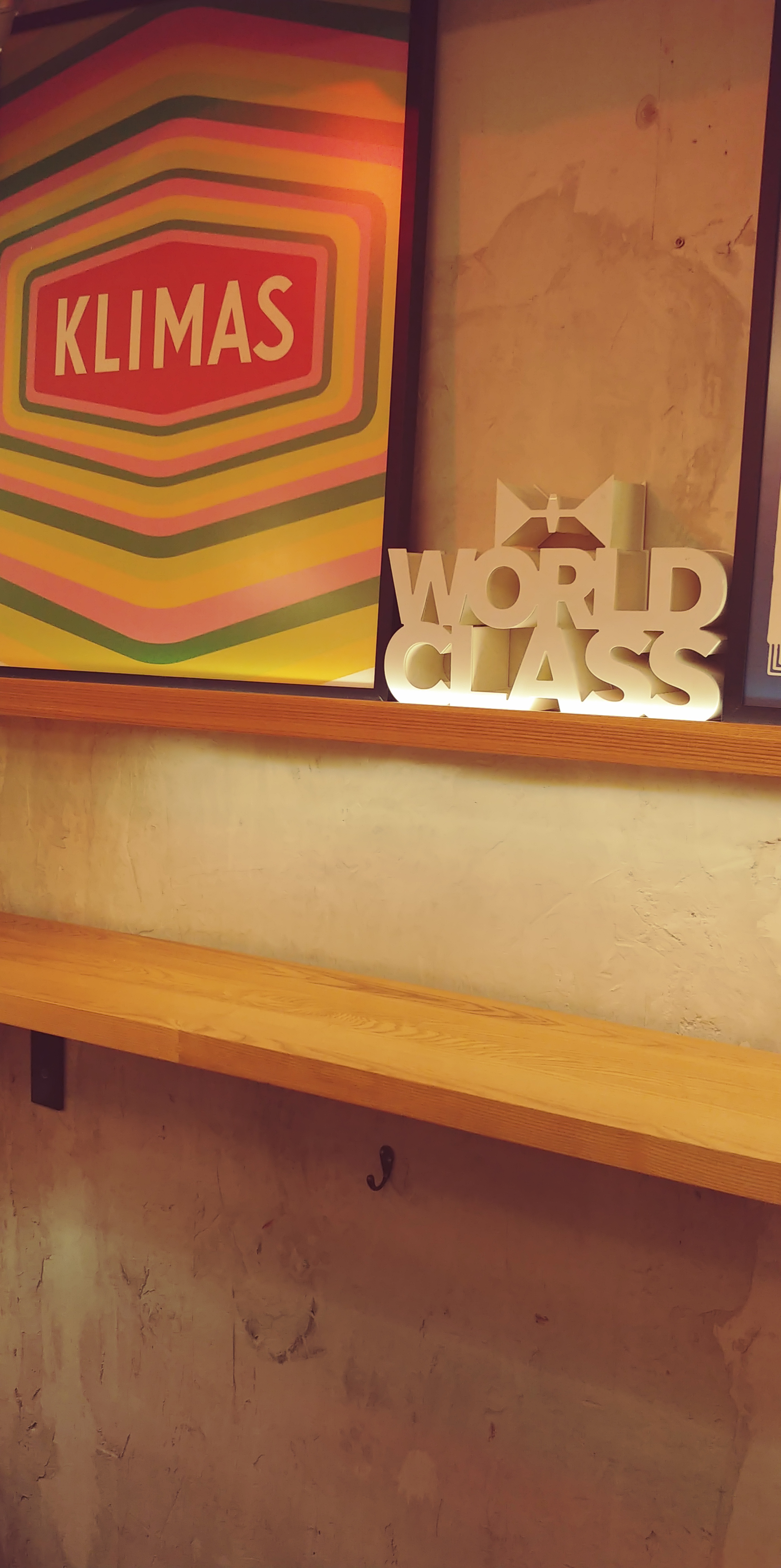
Well, look what we found in Kaunas during our wanderings.

The Klimas pub in Kaunas.
Kind of speaks for itself, right?
Petras Klimas

Petras and 19 other Lithuanians signed the Lithuanian Declaration of Independence in 1918, declaring independence from Russia rule. Petras wound up in Russian prison for awhile and 6 other signatories were executed.

After his release, we went on to a successful business career. He was quite a character as evidenced by the historical references around the bar. The bartender told us a few stores about Petras and included the fact that Klimas is a very common Lithuanian name.

Map progress – none, still in Kaunas.